| Adrian Dening's |
| Stars Over Somerset |
|
Latest News
|
|
Latest News
|
| My weekly articles about what can be seen in the night sky over Somerset are broadcast every Thursday to Sunday at various times, on Yeovil's local community radio station Radio Ninesprings. |
 |
| Since 2022, Greg Perkins has been broadcasting the articles on Apple FM in Taunton. |
 |
| BBC Somerset also transmits Stars Over Somerset on Luke Knight's Friday evening show. |
 |
| Please click on the link below to hear the interview that I gave BBC Somerset: |
| Adrian Dening & Luke Knight Interview MP3 |
 |
| Monday 4th to Sunday 10th May 2026 |
|
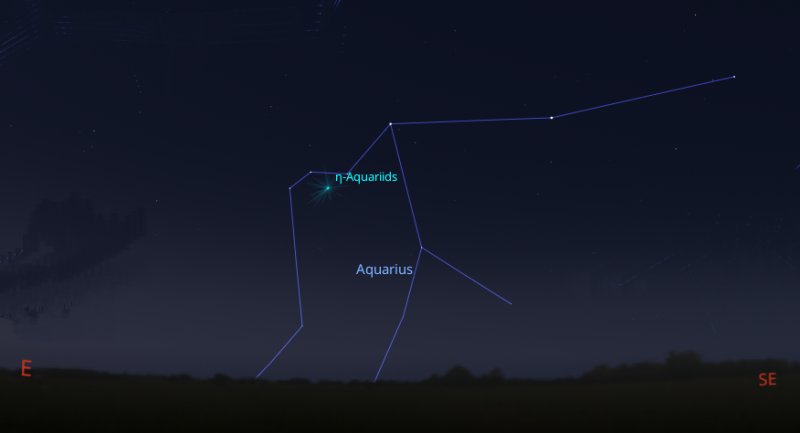
The morning of Tuesday 5th May sees the peak of the annual Aquariids meteor shower. At 4am, the constellation of Aquarius, where the radiant point of the shower is located, will be rising above the east south east horizon. |
 |
|
At its peak, the Aquariids can produce up to a very respectable 55 shooting stars per hour, but don't get too excited as the conditions are not the best for viewing the show - the meteors will be close to the horizon, it will be starting to get light and there will be some light pollution from a waning gibbous Moon off to the south. |
|
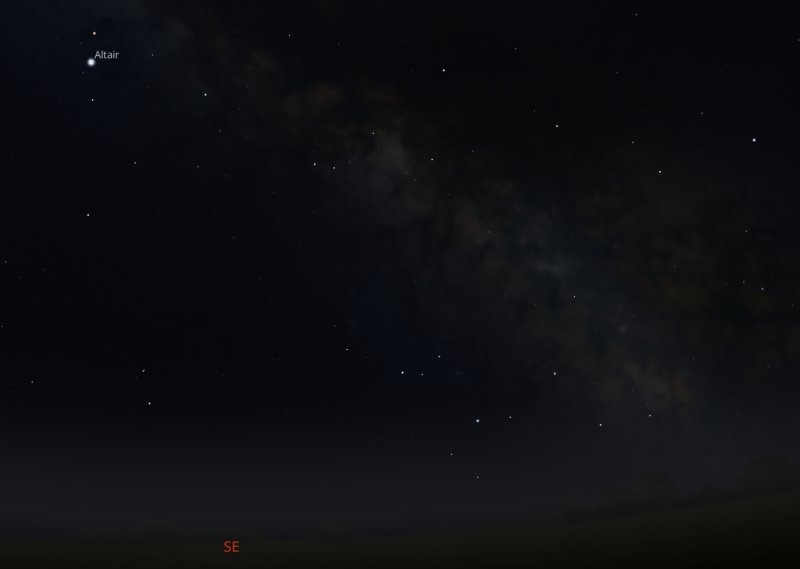
I'm going to suggest a couple of challenges for the early morning of Sunday 10th - one for the naked eye and one that will need a telescope. Look towards the south east at 2am, before the Moon rises above the horizon. The bright star Altair in the constellation of Aquila should be obvious and if you are in a nice dark location, you should be able to observe what looks like faint cloud to the right of Altair - this isn't cloud at all, but the dim light from millions of distant stars in the centre of our Milky Way galaxy. |
 |
|
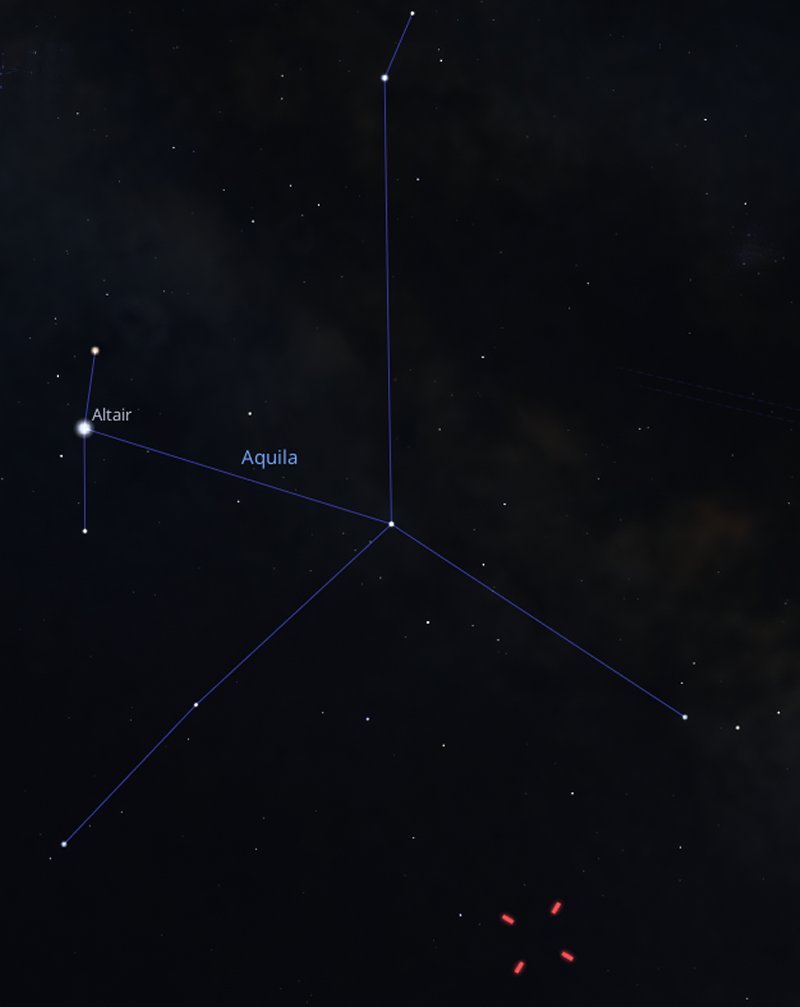
Below the constellation, it should be possible to observe the comet 10P/Tempel, but this will require a telescope as the comet currently only has a magnitude of around +10 |
 |
|
10P/Tempel is classed as a Jupiter-family comet because it orbits the Sun every five years or so, rather than longer-period comets that originate from the Kuiper Belt and beyond in the outer reaches of our Solar System and take hundreds of years to complete an orbit. |
|
The comet spends the whole of the month passing under Aquila, so if you miss it on 10th, there will be plenty more opportunities. Now with all that talk of Milky Ways and Galaxies....I'm off to get a bar of chocolate! |
| Monday 27th April to Sunday 3rd May 2026 |
|
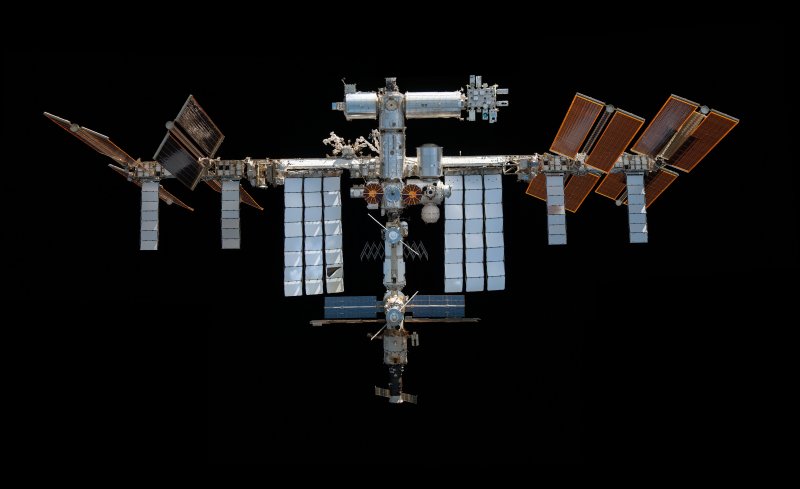
I haven't mentioned the International Space Station recently, but it is still orbiting around us, travelling at a speedy 17,000 miles per hour! There are some good visible passes next week where the ISS will have a magnitude brighter than -3.0 but you will have to stay up late or be a very early riser! |
|
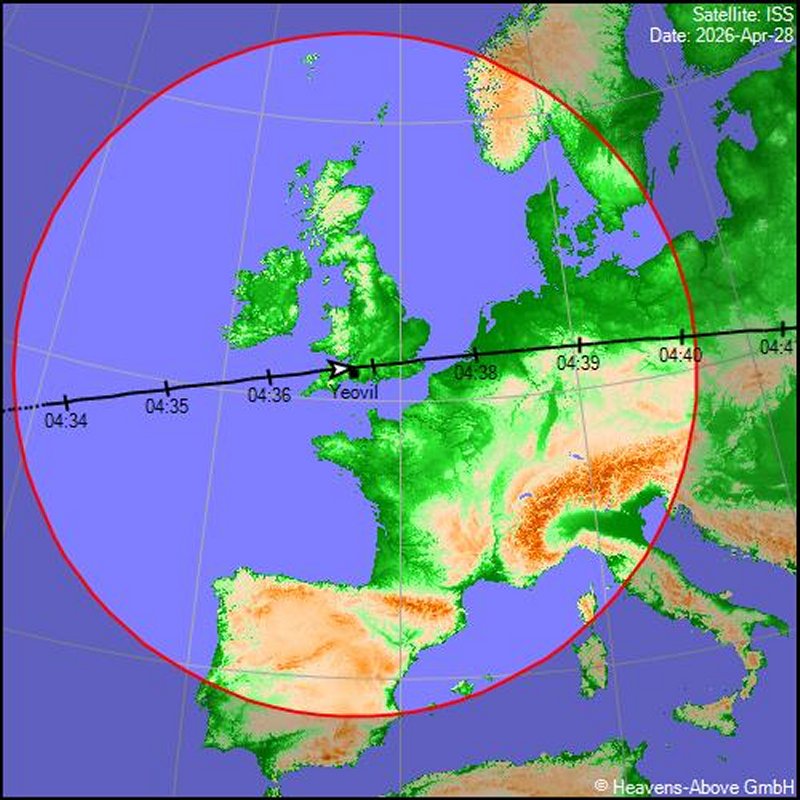
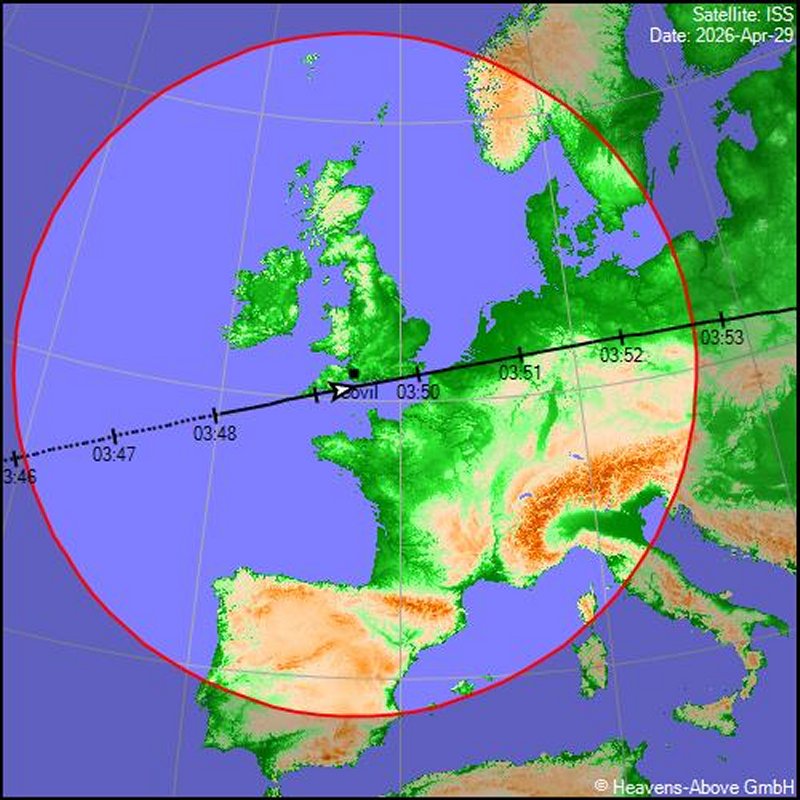
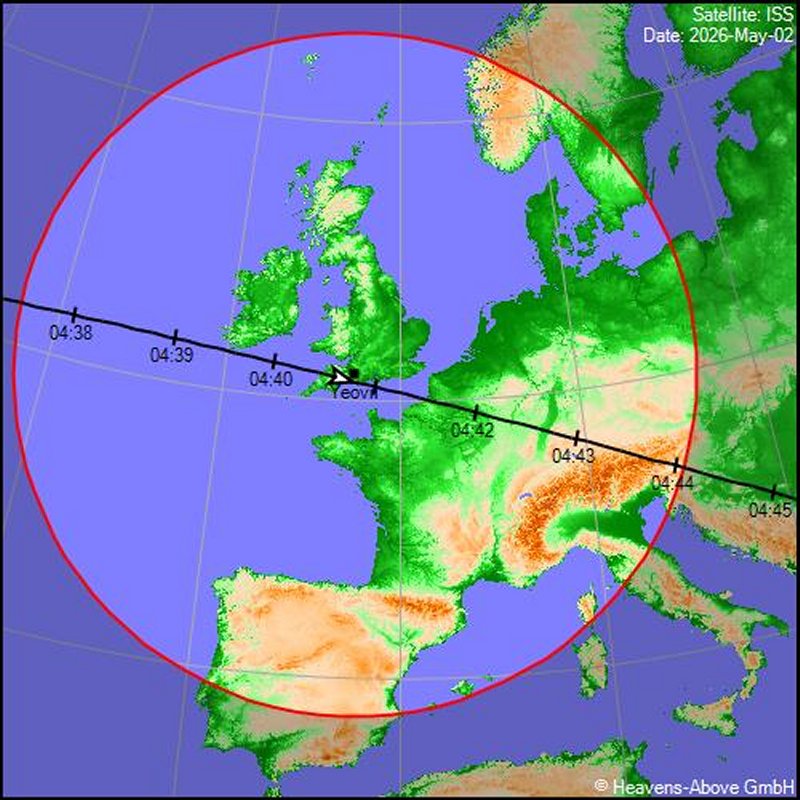
The first pass is on Tuesday 28th April at 4.34am, followed by 3.48am on Wednesday 29th. Or you could try again at 4.37am on Saturday 2nd May. In all three cases, the ISS appears in the west and over a period of about six minutes, passes almost directly overhead, before disappearing towards the east. |
|
You only see the space station because sunlight reflects off its enormous solar panels. The Earth, Sun and ISS all have to be in the right position for this to happen, which is why it can only ever be observed just before dawn or after dusk. The ISS is in (what is classed as) a Low Earth Orbit because it's only about 250 miles above us as it whizzes around the planet every 93 minutes. |
 |
| Image courtesy of Stellarium |
|
So why can't you see the ISS every day? Of course, while it is orbiting the Earth, we are rotating on our axis - sometimes the ISS is passing over a different part of the Earth and not over the UK in the early morning or late evening. |
 |
 |
 |
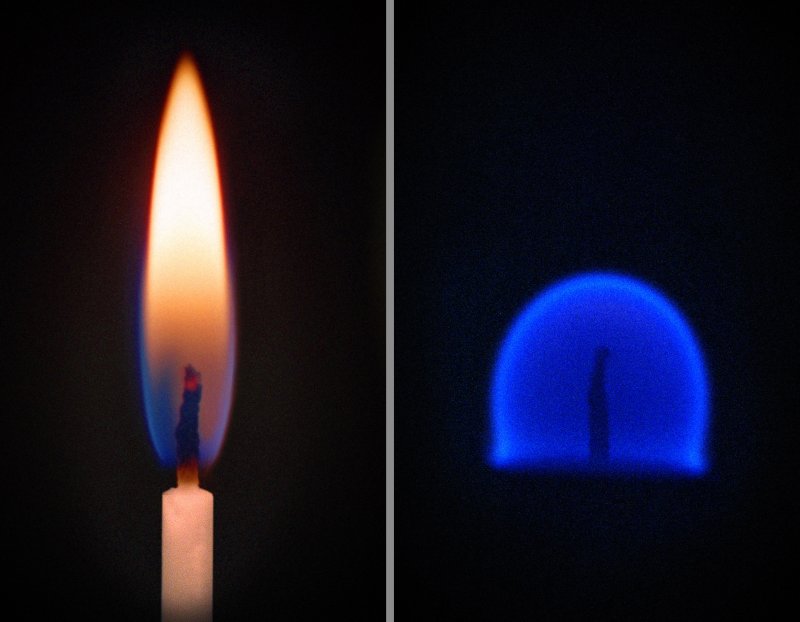
| Overall, the ISS is about the size of a football pitch, but the living space is more akin to the interior of a Jumbo Jet. Inside, the astronauts are conducting all sorts of scientific research - my favourite (and their most basic) one is demonstrating how a candle burns differently in microgravity! |
 |
| Image courtesy of Stellarium |
| Monday 20th to Sunday 26th April 2026 |
|
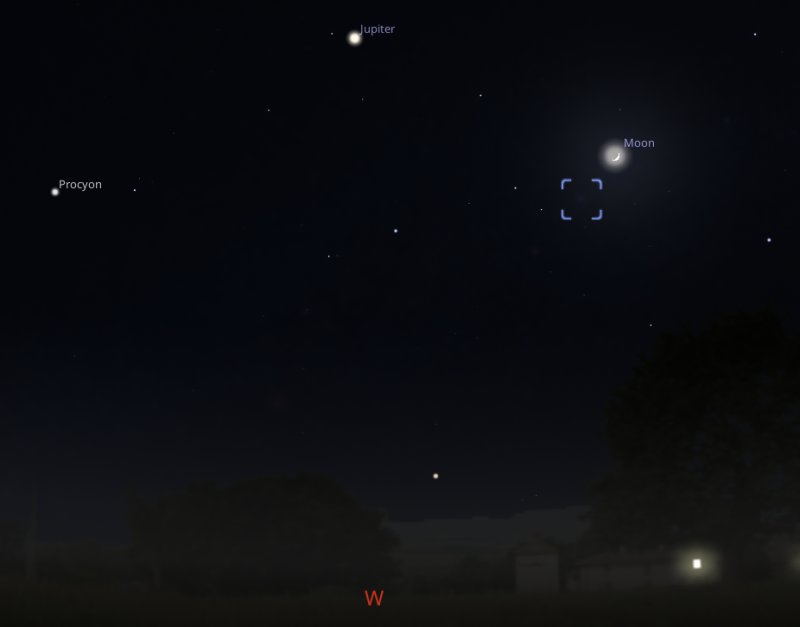
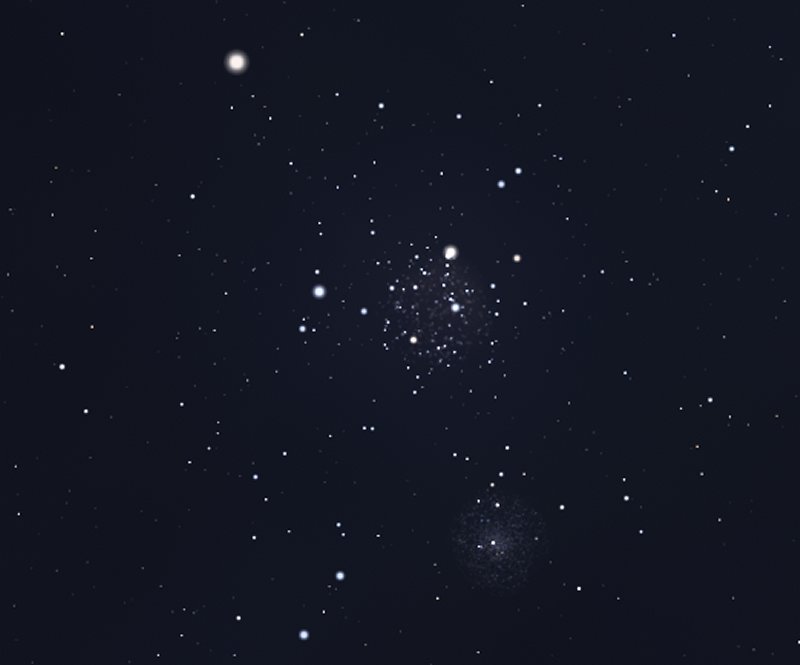
Look towards the west around 11pm on Tuesday 21st to spot a 25%-lit waxing crescent Moon with Jupiter shining brightly to the left of it. Just below the Moon will be an open cluster of stars called the Shoe Buckle Cluster or M35 in the Charles Messier catalogue. |
 |
|
The cluster has a magnitude of +5.1 so in theory, it could be possible to just make it out with the naked eye from a dark location, but there will be a bit of light pollution from the Moon. |
 |
|
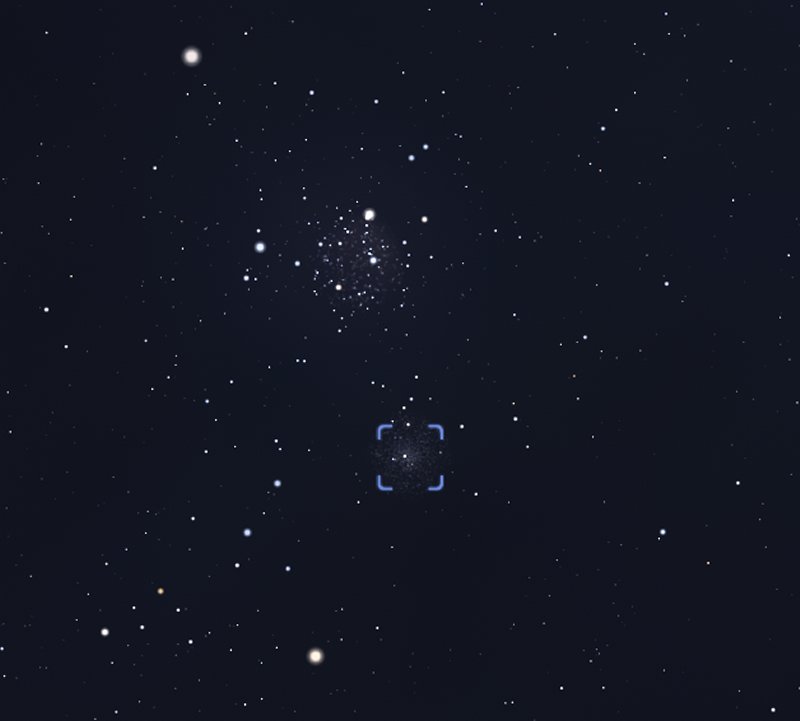
Maybe best to take your binoculars or a small telescope out with you and if you do this, you might also notice a faint fuzzy blob below the cluster - this is magnitude +8.6 NGC2158 which is another open cluster containing about 3000 stars 11,000 light years away from us. |
 |
|
By contrast, M35 contains a similar number of stars, but it is only around 3000 light years away, so is brighter. |
|
The catchy name of NGC2158 refers to the cluster's entry in the New General Catalogue. It doesn't have a Messier number because Charles Messier never spotted it! |
|
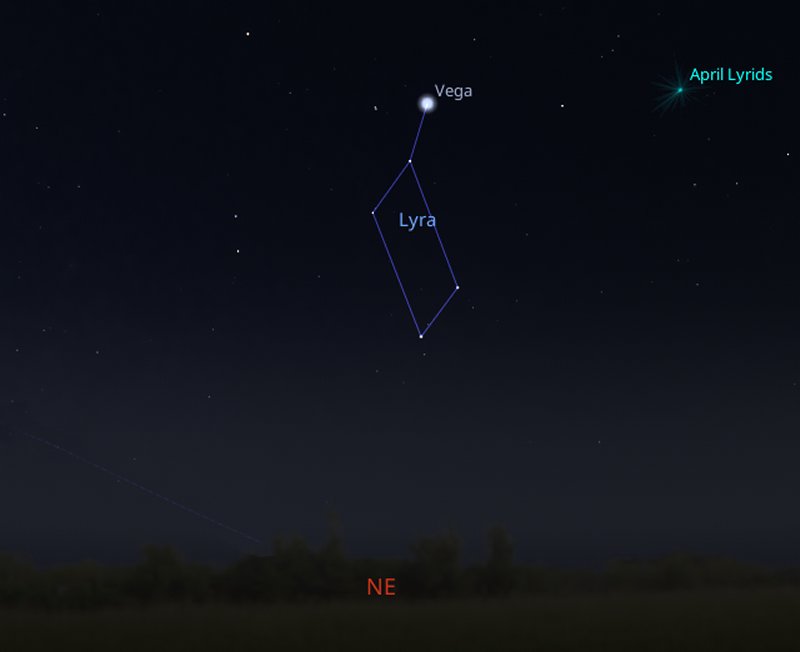
The following evening, Wednesday 22nd, into the early hours of Thursday morning sees the peak of the annual Lyrids meteor shower. At 10pm, the constellation of Lyra will have risen about the north east horizon and the radiant point, where the shooting stars appear to originate from, is a little to the right of the constellation's brightest star, Vega. |
 |
|
At its peak, the shower can produce around 18 meteors per hour. Fortunately, the Moon will be off to the west, in the opposite part of the sky, so the light from it won't spoil your view. |
| Monday 13th to Sunday 19th April 2026 |
|
By the time you hear this broadcast, the Artemis II mission will hopefully have returned safely to Earth, paving the way for what will be the first Moon landing in over fifty years! Unlike the crew of Artemis II, we will never see the far side of our celestial neighbour first-hand, but you can have some fun making observations of the side that always faces us. |
|
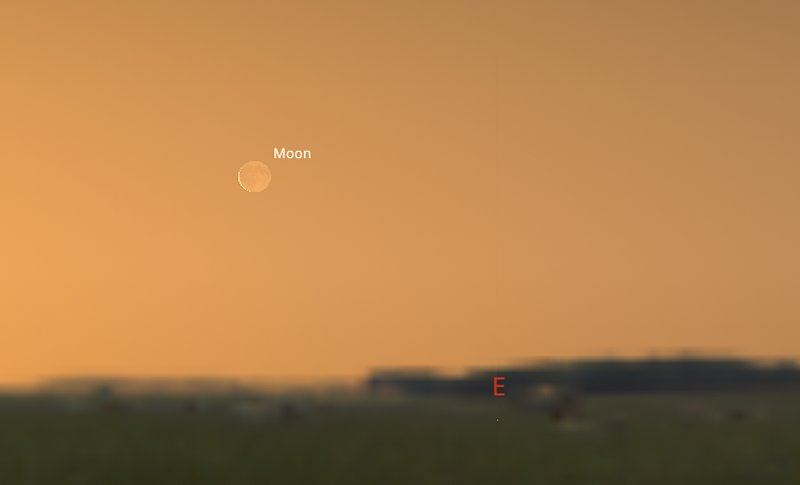
If you are up around 6am on the morning of Thursday 16th, just as it's getting light, you could try to spot a very thin 2%-lit waning crescent Moon rising above the eastern horizon. Because it is "waning" or heading towards a New Moon, it will be the left hand edge of the Moon that is illuminated. |
 |
|
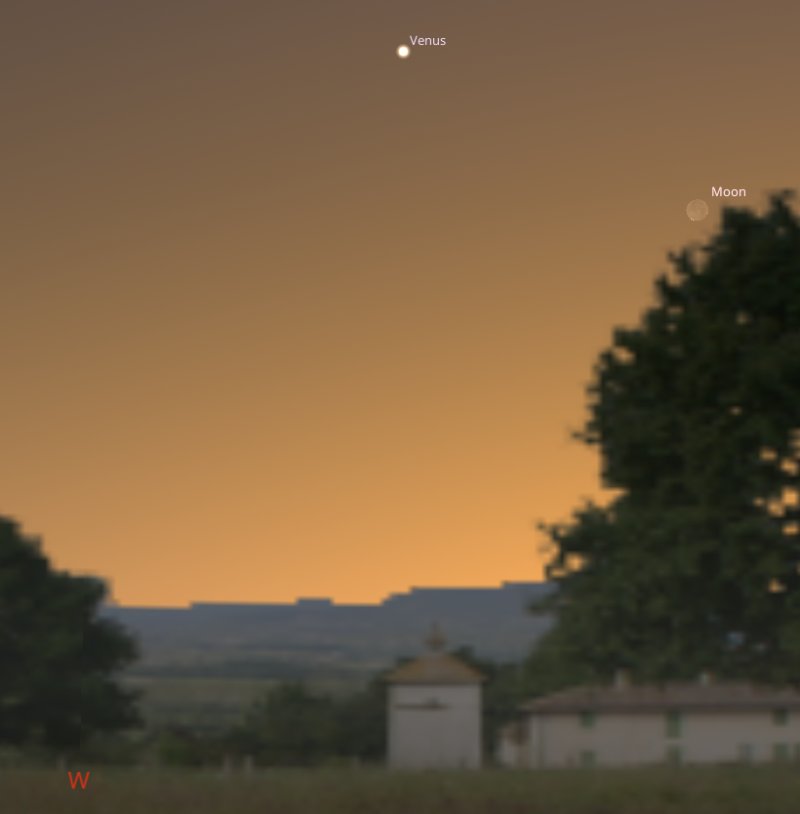
A New Moon occurs on Friday 17th, so if you go back outside and look towards the west around 8pm on the evening of Saturday 18th, an extremely thin waxing crescent Moon will be setting below the horizon. The crescent is called "waxing" because the phase is now past the New Moon and it will be the right hand edge of the Moon that is illuminated. |
|
To the left of the Moon, Venus will be easy to spot, shining at a magnitude of -3.8 which is very bright. |
 |
|
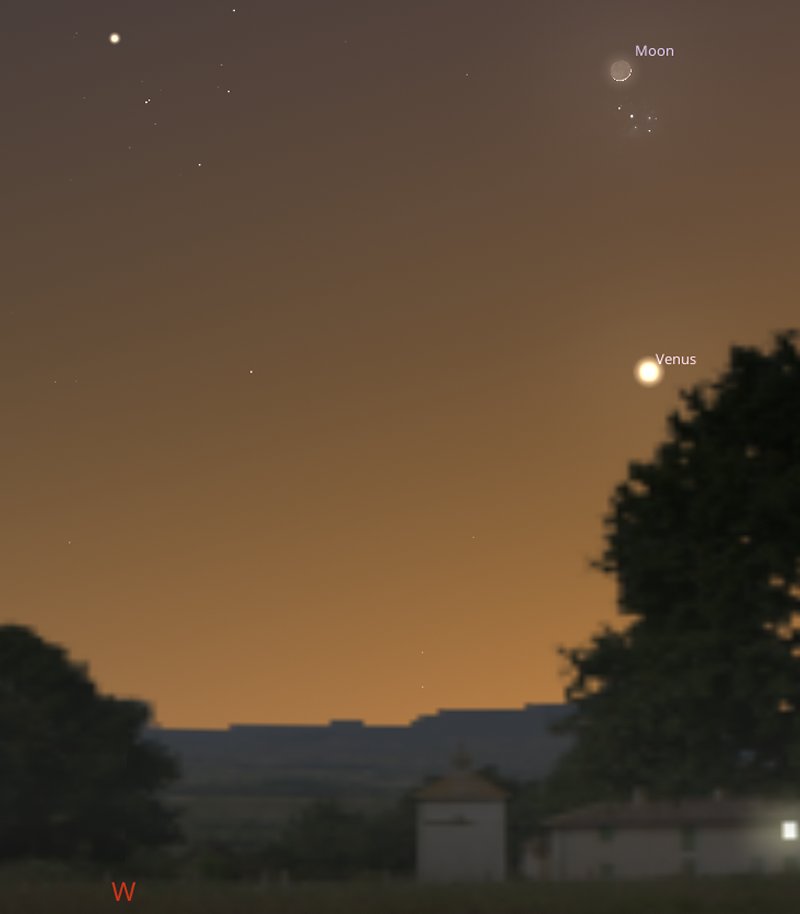
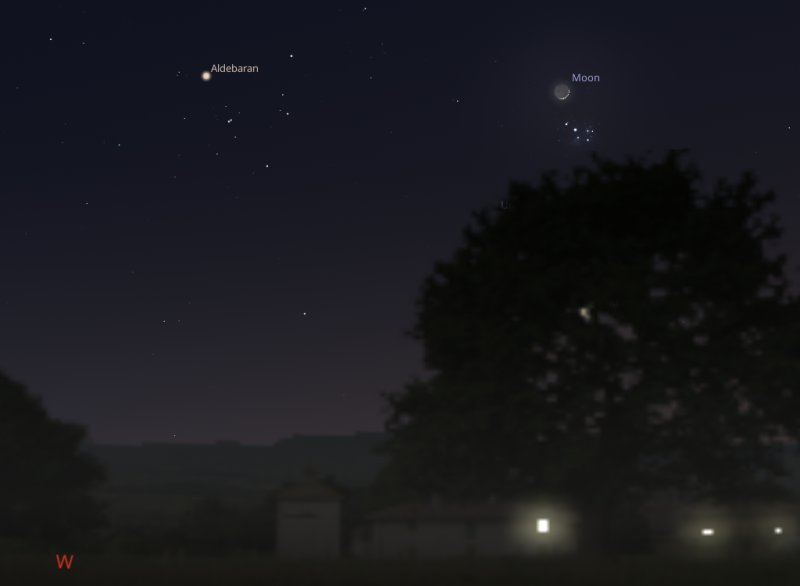
The Moon orbits around us, so on different nights it appears in different parts of the night sky compared to everything else. Repeat the observing experiment at 8pm on Sunday 19th and a 7%-lit crescent Moon, will be located above Venus. In the darkening sky, you may just be able to make out the Pleiades open cluster of stars immediately below the Moon. |
 |
|
If you struggle to see them, stay out until more like 9pm and the pair will then be more obvious as it gets properly dark. |
 |
| Monday 6th to Sunday 12th April 2026 |
|
Venture outside any evening next week after, say 9pm and it will be properly dark. |
|
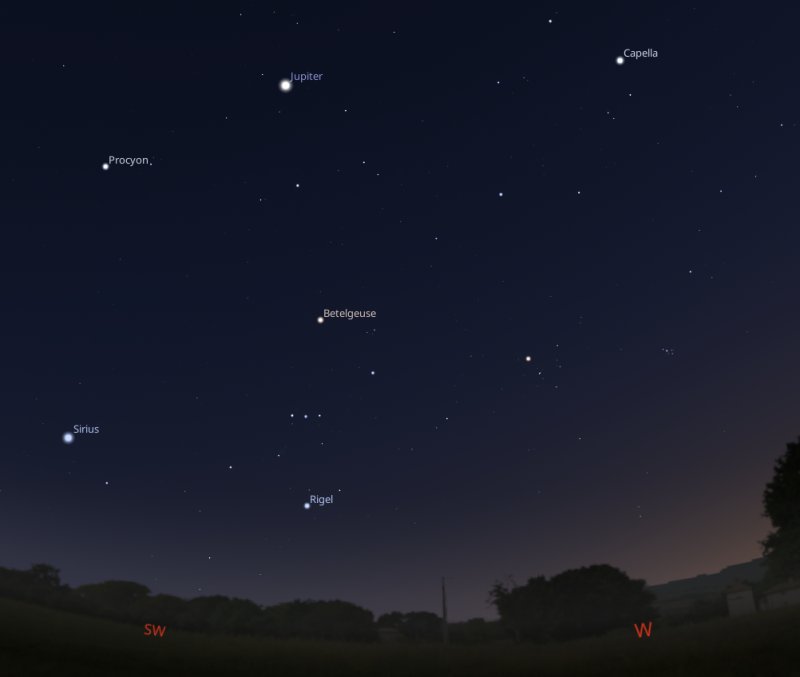
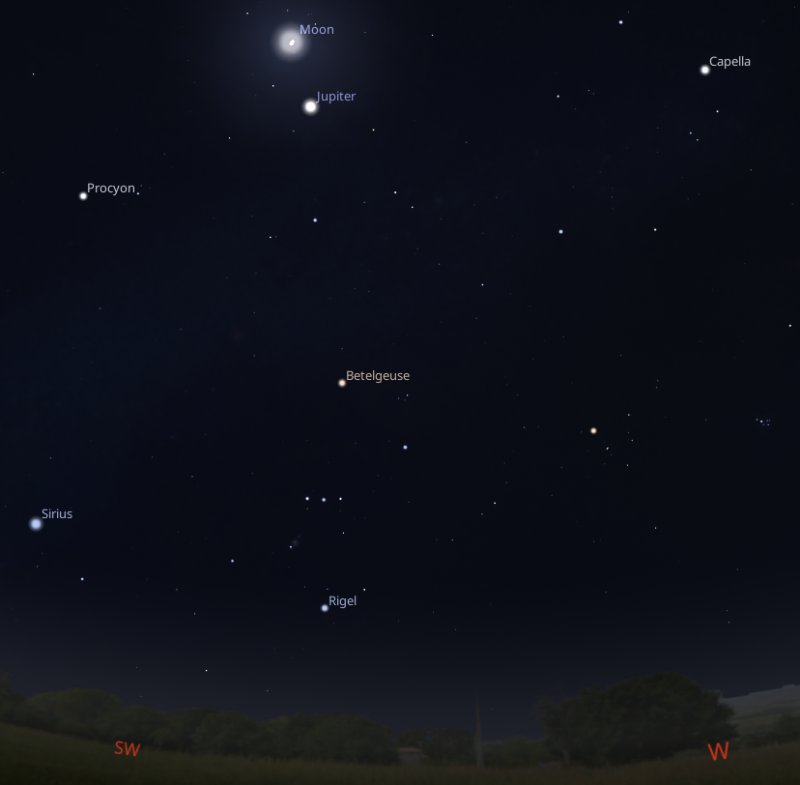
If you look towards the south west around that time, there will be plenty to see. Jupiter will be obvious, shining at a magnitude of about -2.0 and below Jupiter you will see the constellation of Orion, with its bright stars Betelgeuse and Rigel that have magnitudes of +0.45 and +0.15 respectively. Remember that the magnitude scale works backwards, so the more positive the number, the fainter an object is. If something has a negative number, it is very bright, like Jupiter. With the naked eye from a dark location, you can resolve objects down to about +6.0 on the magnitude scale. |
 |
|
To the left of Orion, you will find the brightest star in the night sky, Sirius, that has a magnitude of -1.45 which is almost as bright as Jupiter. Two more of the brightest stars will be located either side of Jupiter - to the left will be Procyon with a magnitude of +0.4 and Capella, magnitude +0.05 to the right. |
|
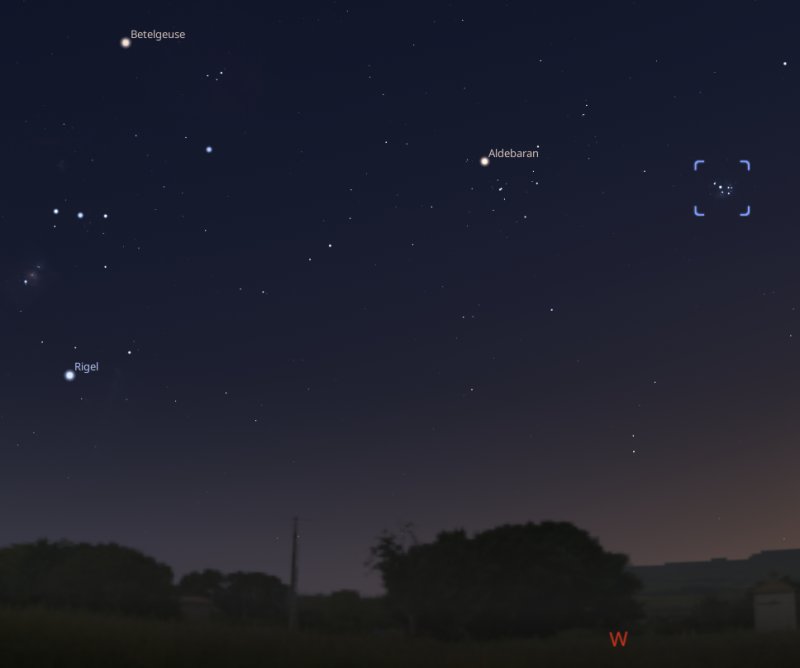
To the right of Orion, more to the west, will be a further bright star, Aldebaran and to the right of that, the Pleiades open cluster of stars. Aldebaran has a magnitude of +0.85, while the Pleiades overall is around +1.2 |
 |
|
Now it's all well and good constantly quoting these figures, but does it really matter? Why not spend a few minutes observing to see whether you can spot a noticeable difference between everything using your naked eye. Some of the stars I have mentioned are red giants - can you identify them compared to the younger stars that have a more blueish colour? |
| Monday 30th March to Sunday 5th April 2026 |
|
Don't forget that we will have changed over to British Summer Time or BST on Sunday 29th March, when the clocks moved forward one hour and we lost a bit of sleep! To keep things simple, through this half of the year, I always quote local observing times in BST. |
|
During the winter months we use GMT or Greenwich Mean Time and GMT is a solar time zone based on the Earth's rotation. Scientists use a different time standard called UTC or Universal Time Co-ordinated, which is based on a high-precision atomic clock. |
|
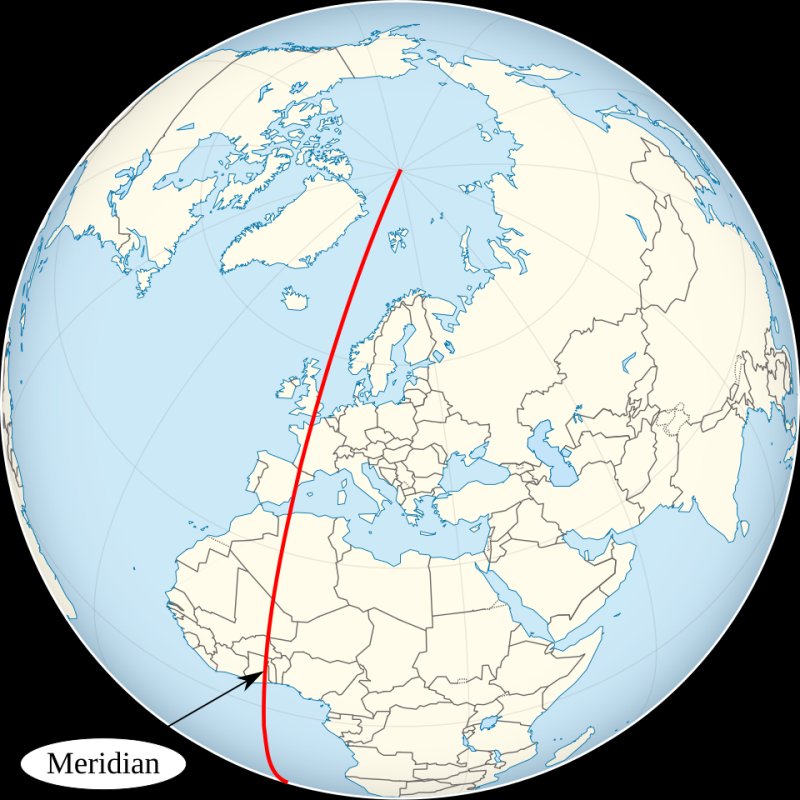
Before UTC came along, GMT was used as the international standard, based on mean solar time at the Prime Meridian, that happens to run through the Royal Observatory in Greenwich. We are lucky in that Greenwich is located in our country and time zone, so we can swap between UTC and GMT directly without doing any maths! |
 |
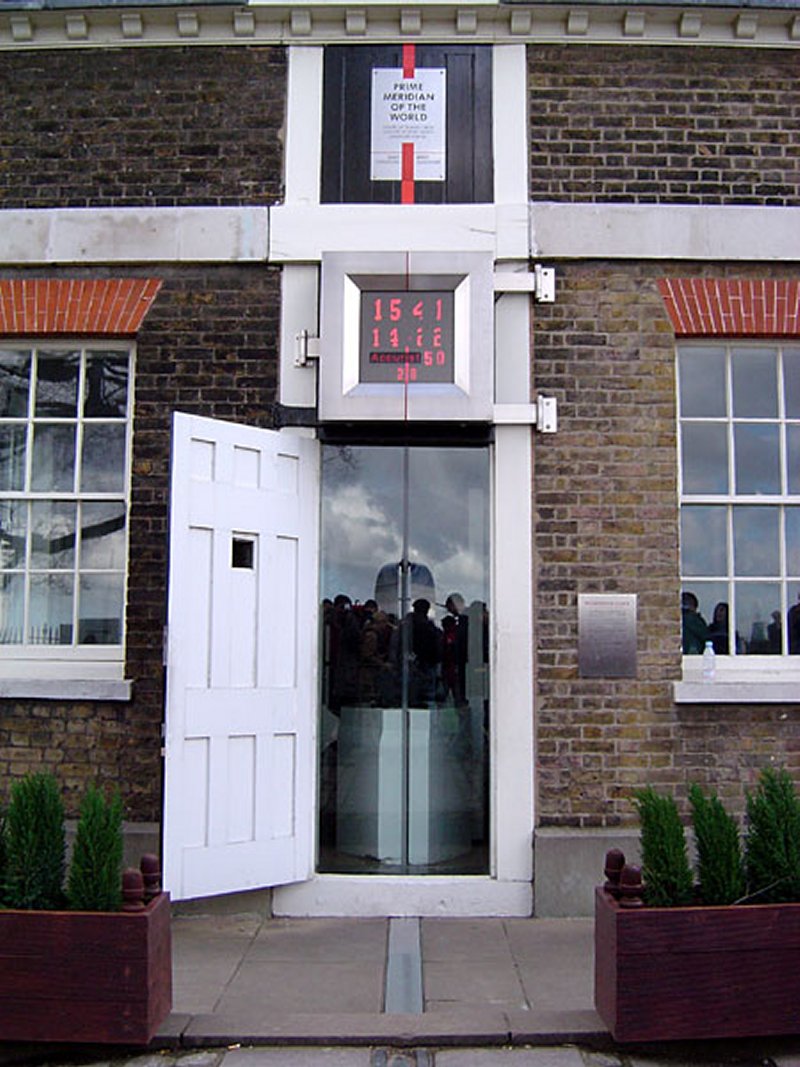 |
|
GMT and BST can be written in a 12-hour or 24-hour format, but to be correct, UTC is only ever quoted using the 24-hour system. 7 o'clock in the evening could be written as 7pm GMT, but must be called 19:00 UTC and never 7pm UTC! |
|
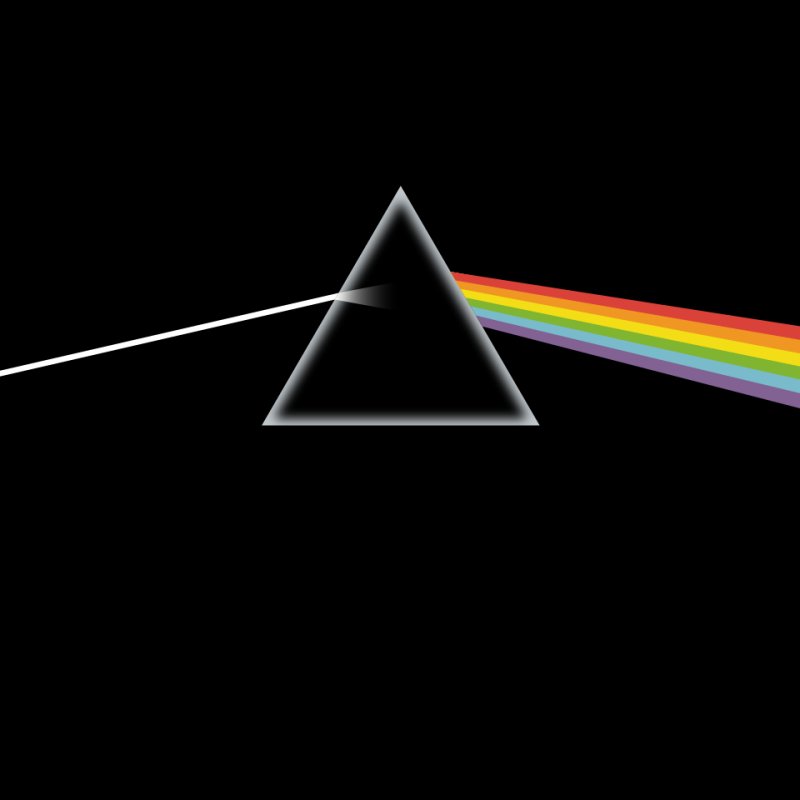
Talking of things being correct, did you know that one of the best-selling music albums of all time is wrong? The "dark side" of the Moon refers to the portion of the lunar surface not illuminated by sunlight on a particular day as our celestial neighbour goes through its different phases. The side of the Moon that is always facing away from us and we can never see it (whether or not it is illuminated by the Sun) is technically known as the "far side". So the Pink Floyd album should really be called "The Far Side of the Moon"! |
 |
| Graphics and images courtesy of Wikipedia |
| Monday 23rd to Sunday 29th March 2026 |
|
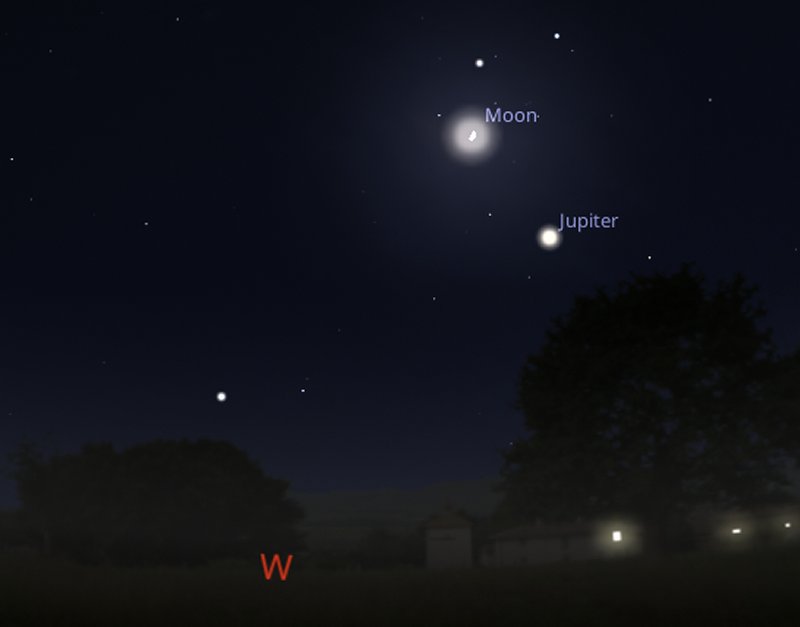
Around 9pm on the evening of Wednesday 25th, the Moon will be visible towards the west south west, with Jupiter quite close to the left of it and the pair will be located above the constellation of Orion with its bright stars Betelgeuse and Rigel. Several more of the brightest stars in the night sky will also be obvious in the same area of the sky. |
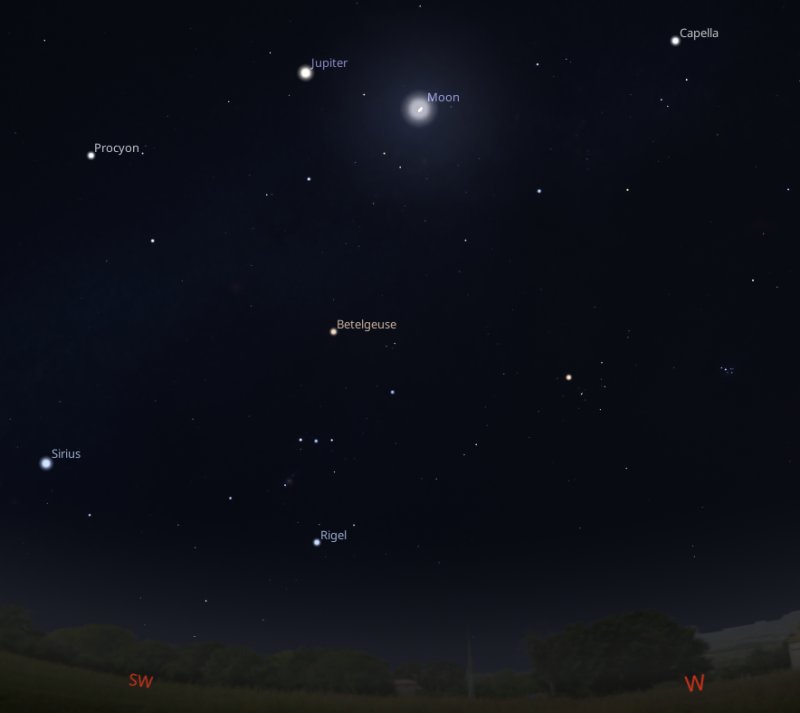 |
|
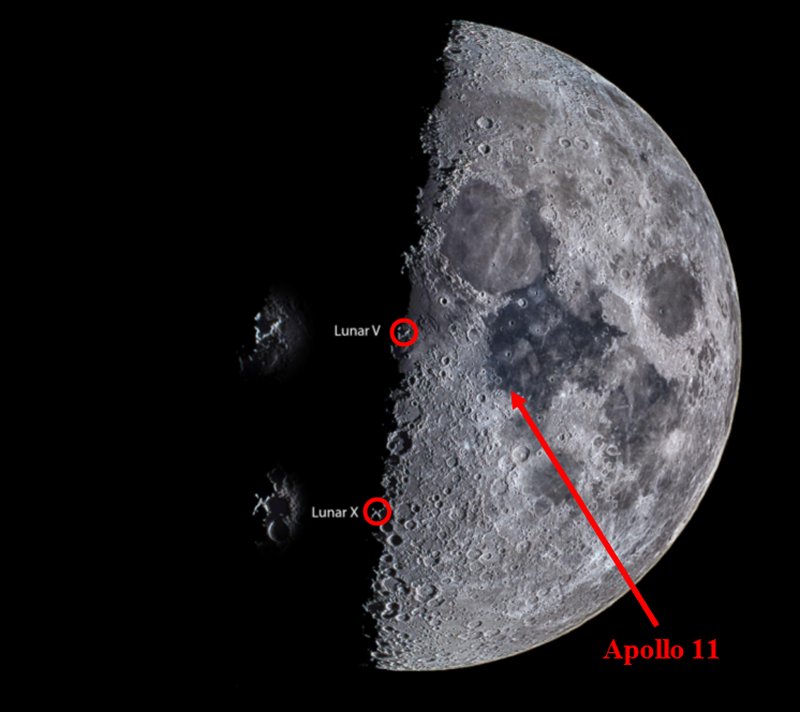
The Moon's first quarter phase that evening will be the optimum time to spot the clair-obscur visual effects known as the "Lunar X and V" in your telescope. |
 |
|
Repeat the experiment at 9pm the following evening, Thursday 26th and the Moon will now appear as a 61%-lit waxing gibbous phase. It will be located slightly above Jupiter this time. You won't be able to see the Lunar X and V any more though, because sunlight will no longer be illuminating those features at the correct angle. |
 |
|
If you can bear to stay up until 2am on the Friday morning, the Moon will be about to disappear below the western horizon. This is the optimum time to spot another clair-obscur effect known as the "Eyes of Clavius". Sunlight illuminates the rims of two small craters, Clavius C and D that are located within the larger main Clavius crater, resembling a pair of eyes staring at you! |
 |
|
Clavius is located towards the very bottom of the Moon that faces us, below the huge, obvious crater Tyco. Don't forget though that when you use your telescope, everything is upside-down, so Tyco will appear towards the top of your eyepiece and Clavius will be above that! |
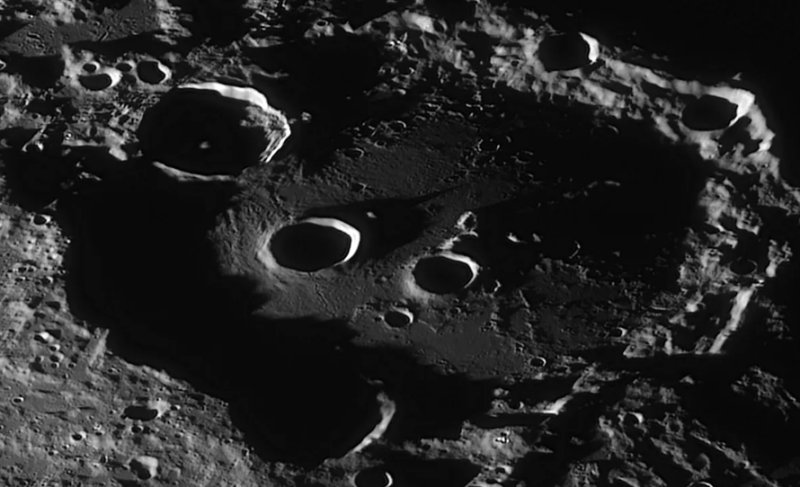 |
| Eyes of Clavius image courtesy of Avani Soares |
| Monday 16th to Sunday 22nd March 2026 |
|
I'm going to stick with the visual challenges theme for another week. |
|
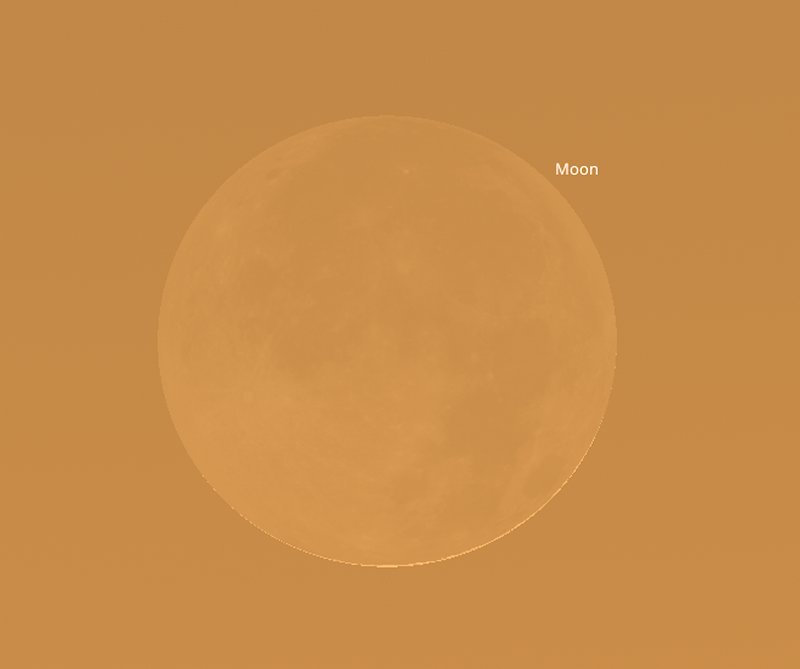
On Thursday 19th we will have a New Moon. This phase of the Moon is always very hard to observe because the side of our celestial neighbour that is facing us is not lit by sunlight at all. |
|
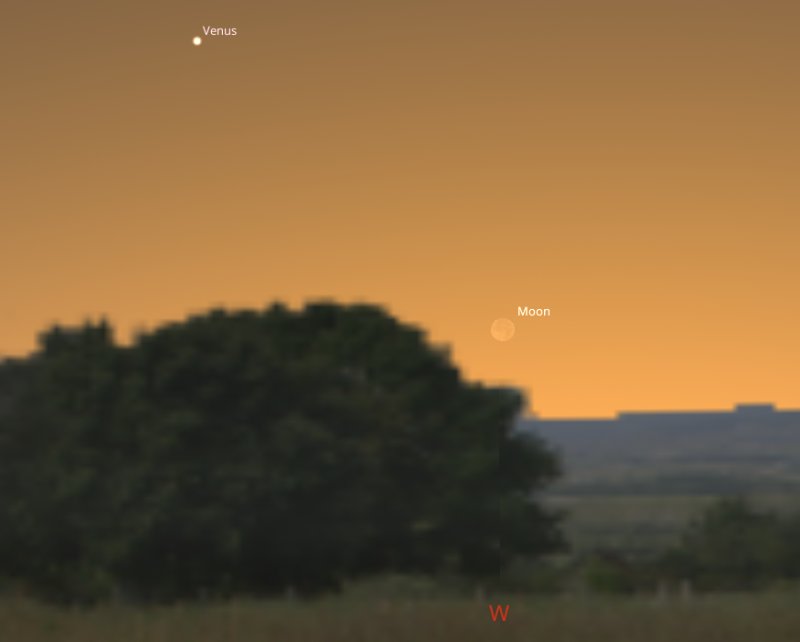
If you look towards the west at 6pm on the Thursday evening, the Moon will be just about to set below the horizon, with Venus shining brightly a little above and to the left of it. |
 |
|
Because of the angles between us, the Sun and the Moon, on this occasion it should be possible to actually make out a very thin crescent shape. |
 |
|
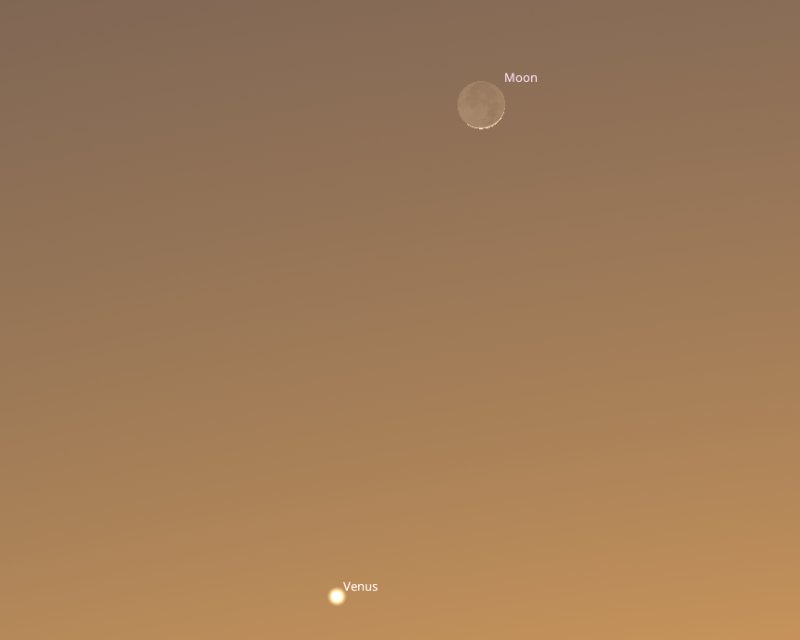
Moving on a day to the same time on Friday 20th, the Moon will now appear as a thin 3%-lit waxing crescent and because of the way it orbits around us, the Moon will now be a little above and to the right of Venus as the pair set below the western horizon. |
 |
|
Coincidentally, Friday 20th is the spring equinox, when we have equal periods of day and night. In other words, hang in there, as we will be halfway towards the longest day and those balmy summer nights! I don't normally run astronomy sessions during the summer months because of the light evenings, but due to my previous talks this winter being over-subscribed, I have agreed to do one more at the Ham Hill Visitor Centre on Thursday 26th March. |
|
To reserve a place before it's too late, please email: |
| countryside@somerset.gov.uk |
| Monday 9th to Sunday 15th March 2026 |
|
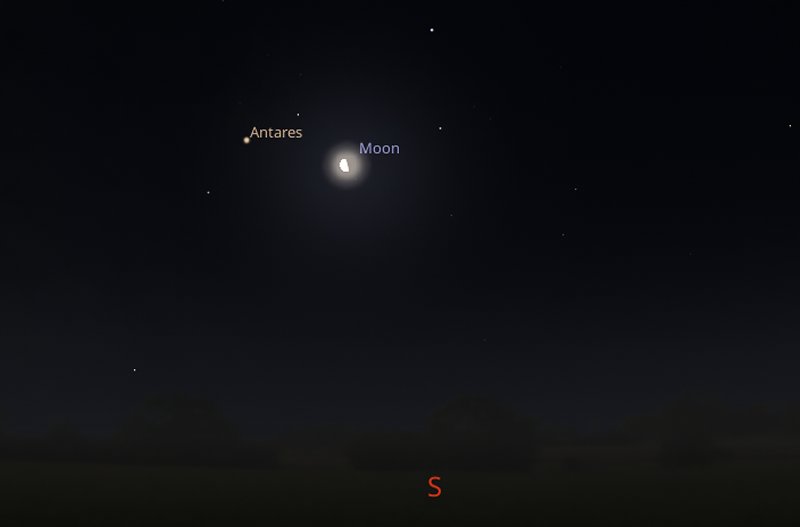
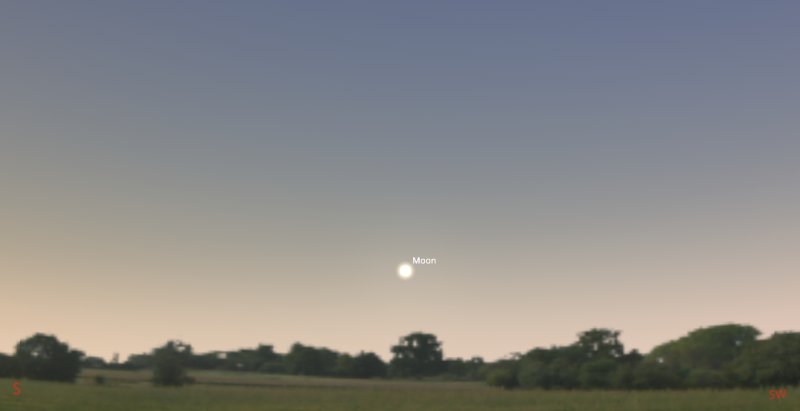
It's fairly quiet on the astronomy front next week, so I'm going to suggest trying a little visual experiment on the morning of Tuesday 10th. If you look towards the south at 5am, a 61%-lit waning gibbous Moon will be easy to spot, with the red giant star Antares just to the left of it. |
 |
|
The Moon will have a magnitude of around -10.0 and Antares, being one of the brightest stars in the night sky, will be twinkling around -1.65 |
|
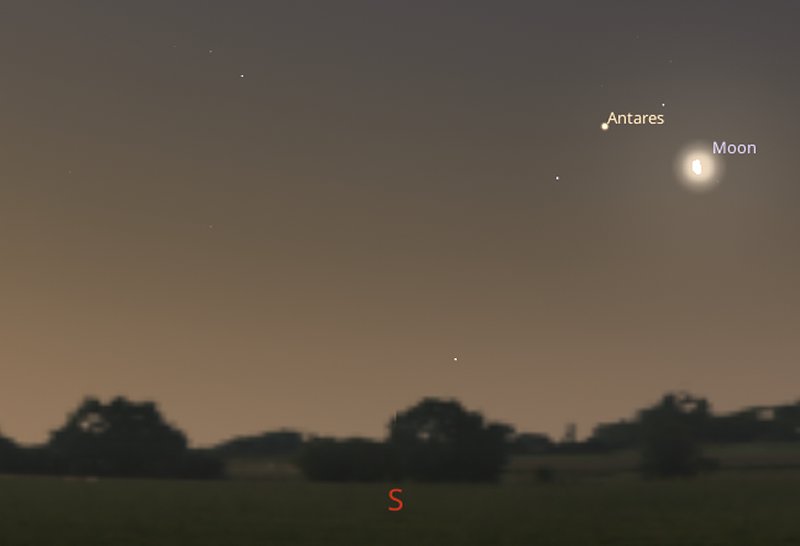
By 6am it will be starting to get light. The Moon will still be easy to see, but can you still make out Antares in the dawn sky? |
 |
|
By 7am it will be properly daylight, but the Moon should still be visible because it is so bright to start with. I bet you won't be able to see Antares any more though! |
 |
|
Now why is this? Sunlight is very bright and it is described as "white light" which is a combination of all the primary colours. Because it is so bright, it completely "washes out" the contrast of fainter things like stars. The sky appears blue because the air molecules in our atmosphere scatter the blue component of the white light which has a shorter wavelength than the colours towards the lower "red" end of the visual light spectrum. |
|
Stars twinkle, but the Moon and other planets in the Solar System don't. The light from a star is generated by the star itself and it then has to travel many light years to reach us, by which time it is relatively weak and it then has to pass through our atmosphere, which distorts the light and creates the twinkle. You only see the Moon and planets because sunlight reflects off their surface, plus they are much closer to us, so the twinkling effect is not noticeable due to the much higher brightness. |
| Monday 2nd to Sunday 8th March 2026 |
|
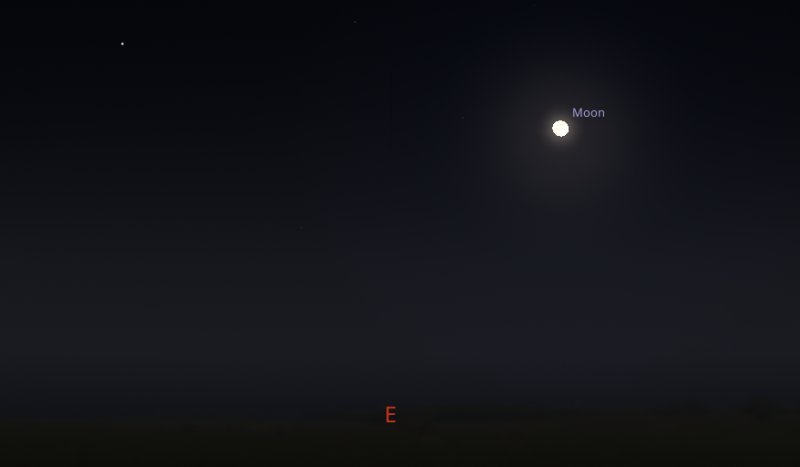
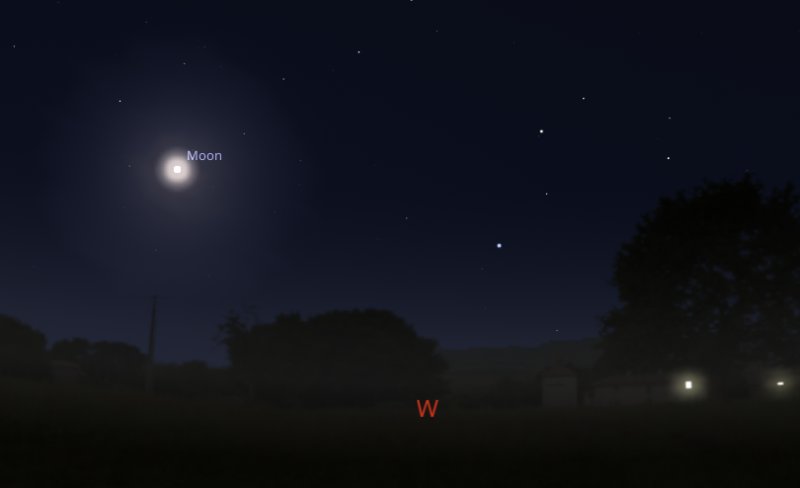
We will have a Full Moon on Tuesday 3rd. It will appear above the eastern horizon just after dark and spend the whole night tracking through the sky to the south, before disappearing below the western horizon just before daybreak. |
 |
 |
|
This is the worst possible time to go hunting for faint deep sky objects, as a Full Moon is the ultimate source of light pollution. Of course, if you want to observe details on the lunar surface, then this is the best time to do it! A Full Moon is very bright though, around a magnitude of -12.0 and if using a telescope, you will need a special filter, known as a neutral density filter, on the eyepiece to reduce its glare to a comfortable level. Think of the filter as being like a pair of sunglasses for your eyepiece, typically allowing only 13% of the sunlight reflected from the Moon's surface to pass through to your eye. |
 |
|
If you look towards the west around 6.30pm on Saturday 7th, it should be possible to spot Venus and Saturn very close together, setting below the horizon. Venus will be quite bright, shining at a magnitude of -3.0 while Saturn will be dimmer at a magnitude of around +2.0 |
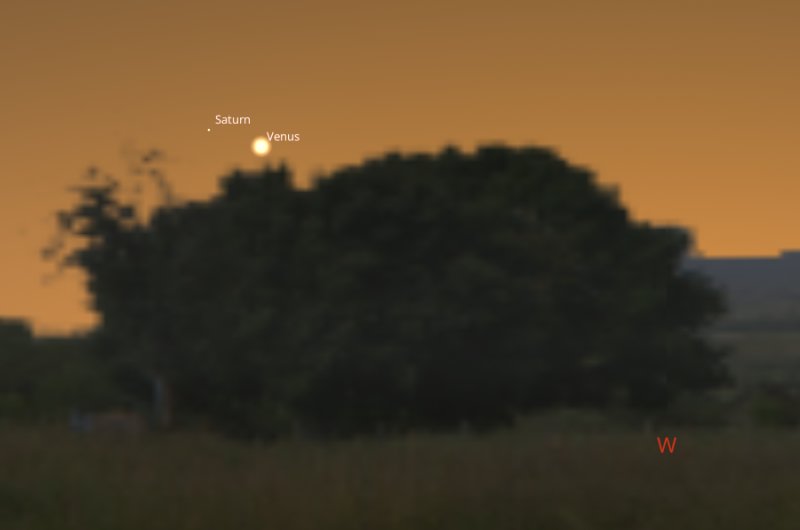 |
| In theory at least, it should also be possible to see Neptune just below Venus, but this would very tricky in the twilight sky and would most definitely require a telescope. |
|
If you are using a telescope to try and catch the trio of planets, please make sure that the Sun is completely below the horizon before you aim in that direction. Catching even a momentary glimpse of the Sun in your eyepiece will cause instant and permanent blindness.....and a neutral density Moon filter won't cut the mustard as it would need to filter more like 99% of the light! |
|
Screenshots courtesy of Stellarium |
|
Copyright Adrian Dening and Radio Ninesprings 2026 |
| To enquire about local astronomy talks and star parties |
| please contact Adrian Dening |
| 07545 641068 |
| info@starsoversomerset.com |
| Designed for 1024 x 768 resolution |