|
Monday 22nd to
Sunday 28th December 2025 |
| |
|
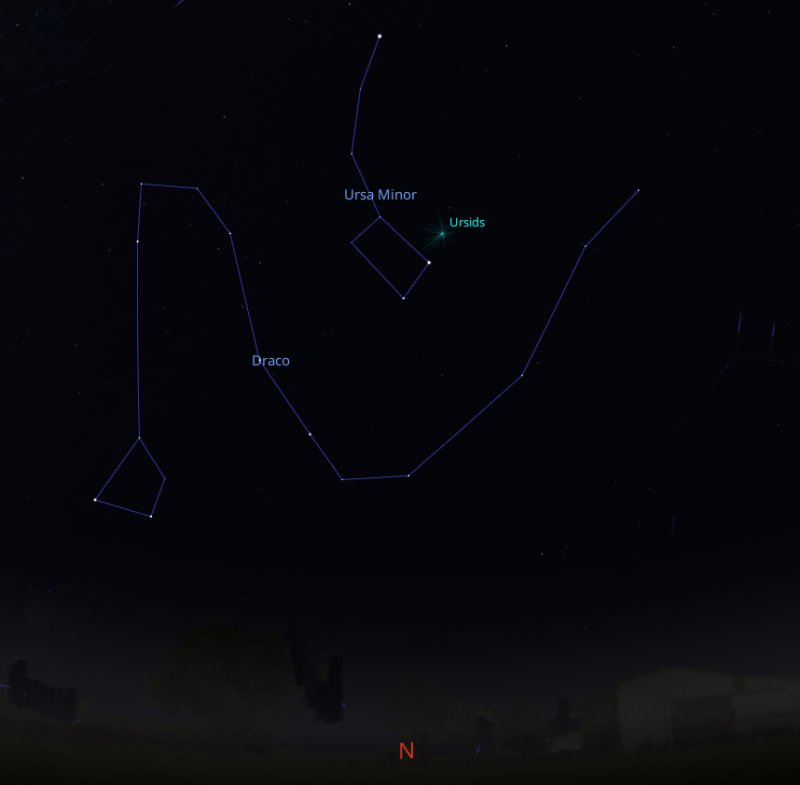
The evening of Monday 22nd sees the peak of
the annual Ursid meteor shower. If you venture outside from 8pm, the Moon
will have set below the horizon, so there will be no light pollution from
our celestial neighbour. Look towards the north and try to locate Polaris,
the pole star, which appears to be at the far end of the "little saucepan"
Ursa Minor's "handle". The radiant point where the shooting stars appear to
originate from is located below that, nearer the body of the saucepan. |
| |
 |
| |
|
The Ursids is classed as a "sparse" shower,
producing up to ten meteors per hour and it is associated with the debris
left behind by comet 8P/Tuttle, that last orbited close to the Sun back in
2021. Tuttle is known as a "short period comet" as it orbits the Sun every
13.6 years and the comet only travels out as far as Saturn, where most
comets travel all the way to the outer reaches of the Solar System and their
orbits take hundreds of years to complete. |
| |
|
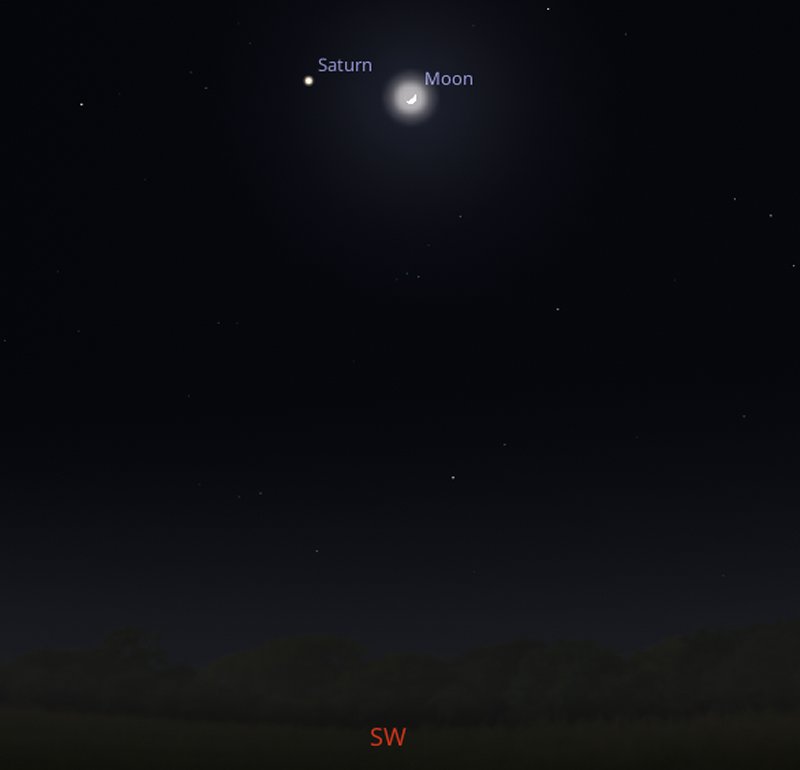
Talking about the Moon and Saturn, if you go
back outside around 8pm on Boxing Day 26th and look towards the south west,
you will see a 39%-lit crescent Moon extremely close to Saturn. |
| |
 |
| |
|
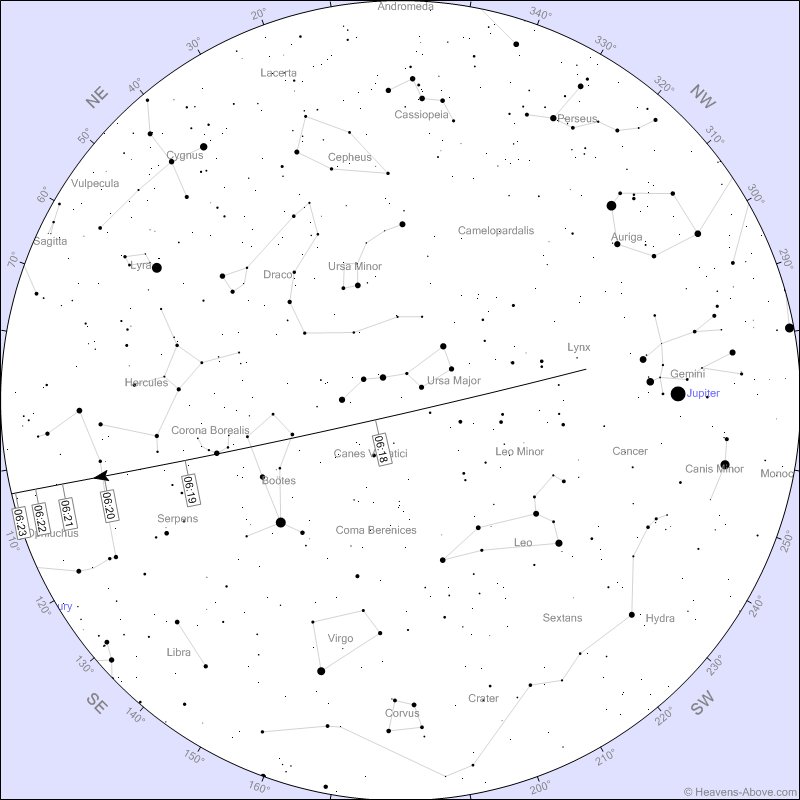
Some very exciting news..........I have seen
a top secret copy of Santa's travel plans for Christmas Day and I can reveal
that he will be passing over the UK just after 6am on Christmas morning. If
you look towards the west at 6.17am, his sleigh will appear as a bright
point of light near planet Jupiter and the constellation of Gemini. He will
pass almost directly overhead, before disappearing towards the east around
6.21am. |
| |
 |
| |
|
On that note, it just remains for me to wish
all our listeners a peaceful and happy festive period, with hopefully some
clear skies! |
| |
 |
|
Monday 15th to
Sunday 21st December 2025 |
| |
|
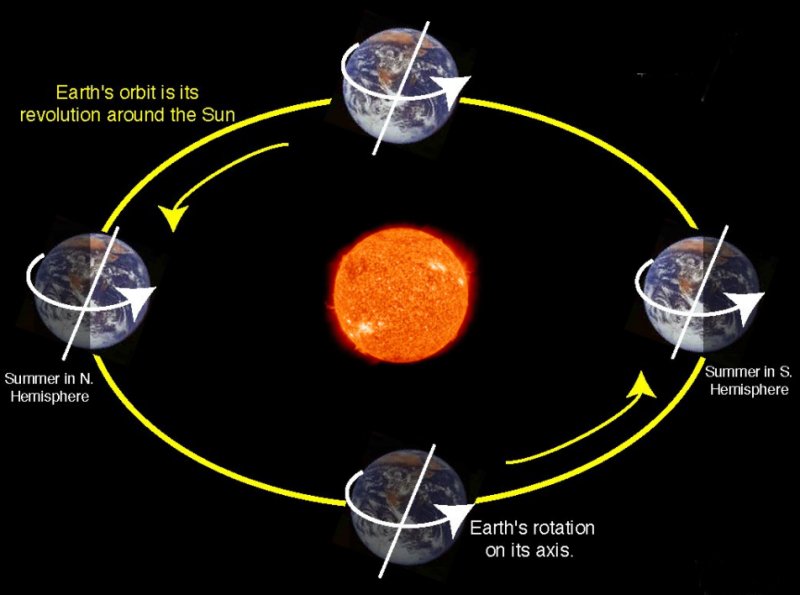
Sunday 21st is the winter solstice, when the
Sun reaches it's lowest point in the sky and the days are shortest. Look on
the bright side - the days are gradually going to get longer now, by roughly
4 minutes each day as we head towards spring and summer. |
| |
 |
| |
|
We have seasons because the Earth is tilted
23.5 degrees on its axis, so the north and south poles are not directly at
the top and bottom. As a child, I always wondered why the Earth on the
classroom globe was mounted wonkey! |
| |
 |
| |
|
Of course astronomers prefer the winter
skies, because it is dark for longer and we can get outside with our
telescopes more, but why by 4 minutes each day? The Earth's sidereal day,
or the time taken for us to rotate once on our axis is NOT 24 hours. It
actually takes 23 hours 56 minutes and 4 seconds. That's why, as we go
through the different seasons, we progressively get lighter or darker each
day by almost 4 minutes. |
| |
|
Things are kept simple in daily life, so we
prefer to work on 24 hours, which divides up nicely into two lots of 12
hours on a clock face. Would you really like to read a clock chopped up
into two halves of 23 hours 56 minutes and 4 seconds! |
| |
|
Our orbit around the Sun takes 365 1/4 days,
but we work on a year being exactly 365 days. We make up the missing
quarters every four years by adding an extra day to February and calling it
a Leap Year. |
| |
|
The Earth spins at just over 1000 miles per
hour and we travel around the Sun at a whopping 67,000 miles per hour, but
you are unaware of it because you are ON the Earth, just like inside a car,
you are not aware of the speed it is going. |
|
Monday 8th to
Sunday 14th December 2025 |
| |
|
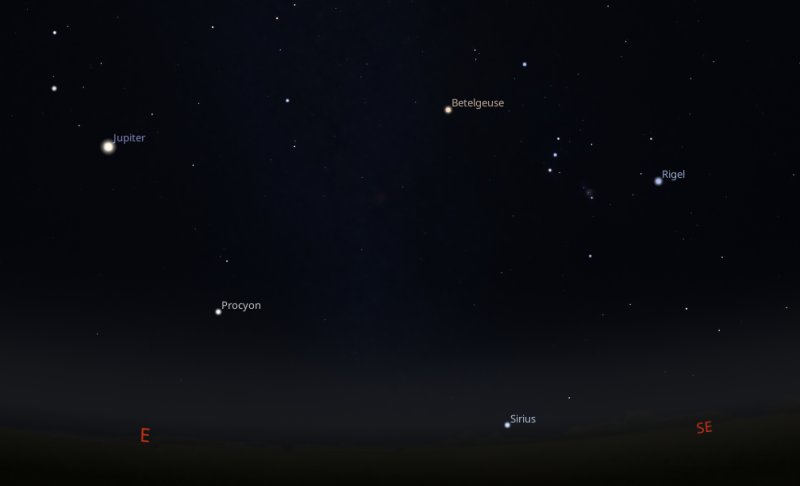
Sunday 14th sees the peak of the annual
Geminids meteor shower. If you look towards the east around 9pm, the bright
star Procyon will be easy to spot, with planet Jupiter above it. To the
right of them, more towards the south east, the constellation of Orion will
be obvious and the brightest star in the night sky, Sirius, will be poking
its head above the horizon. |
| |
 |
| |
|
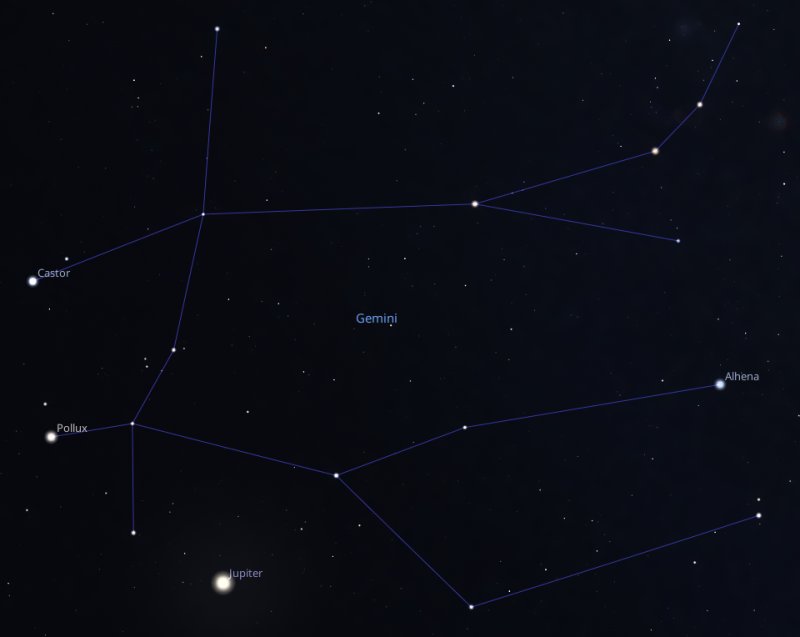
You should notice two bright stars just above
Jupiter - these are Castor and Pollux - the "heads" of the twins in the
constellation Gemini. |
| |
 |
| |
|
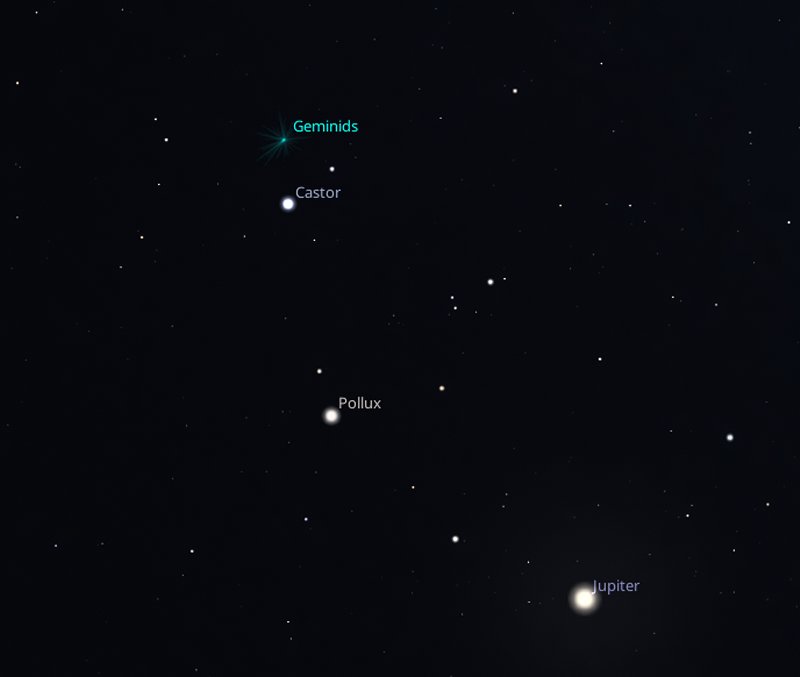
The radiant point of the meteor shower, where
the shooting stars appear to originate from, will be just above Castor. |
| |
 |
| |
|
At its peak, the shower has been known to
produce up to 120 meteors per hour, as the bits of space debris enter our
atmosphere at a speed approaching 70Km per second. This debris is normally
associated with the leftovers of different comets because they melt and
produce a "tail" as they approach the Sun, on their long journey from the
outer reaches of the Solar System. The Geminids is a little unusual, in
that these meteors originate from an Asteroid called Phaethon that is in a
highly elliptical orbit in and out of the Asteroid Belt. Being an asteroid,
Phaethon is rocky, where your average comet is more like a dirty snowball! |
| |
|
So could some of these bits actually get
through the atmosphere without burning up completely and crash into the
Earth? If they did, they would be called meteorites, but that's not going
to happen as they are only tiny to start with. Something the size of a
grain of sand could produce a decent shooting star! |
|
Monday 1st to
Sunday 7th December 2025 |
| |
|
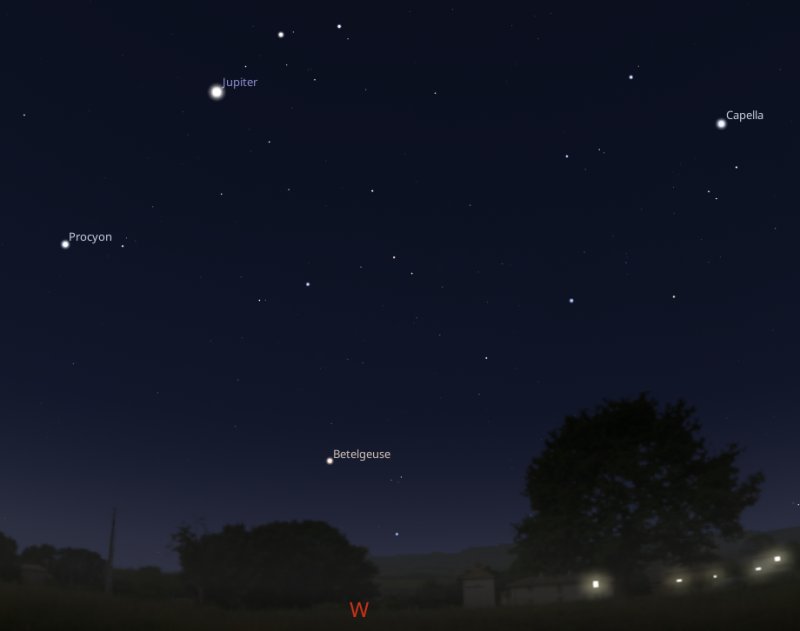
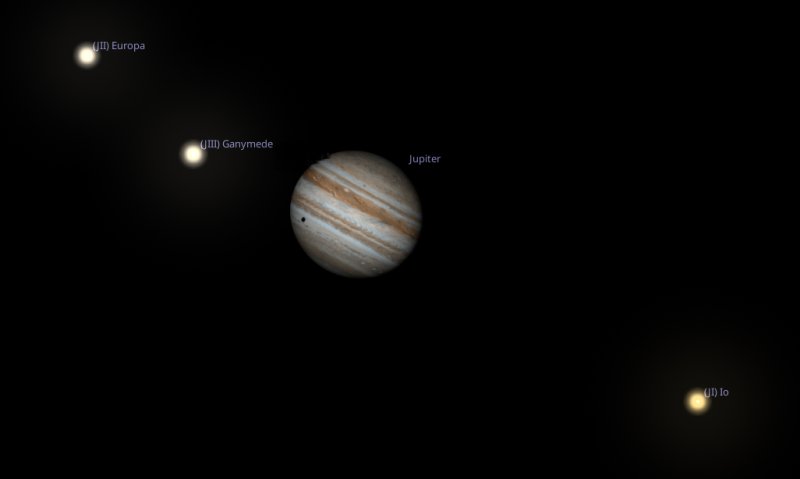
If you missed the shadow of Jupiter's moon
Ganymede being cast on the planet's surface last week, there is another
opportunity to witness it from 6am on the morning of Tuesday 2nd. At that
time, Jupiter will be located towards the west and you will only have a
little window of opportunity before dawn. |
| |
 |
| |
 |
| |
|
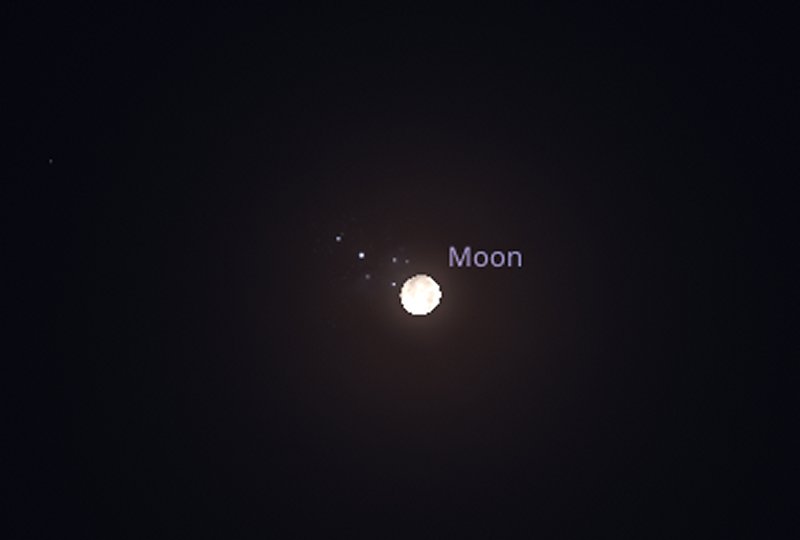
Look towards the west again at 3am in the
early hours of Thursday 4th to see a 98%-lit gibbous Moon occulting (or
appearing to pass in front of) the Pleiades open cluster of stars, Messier
45. |
| |
 |
| |
|
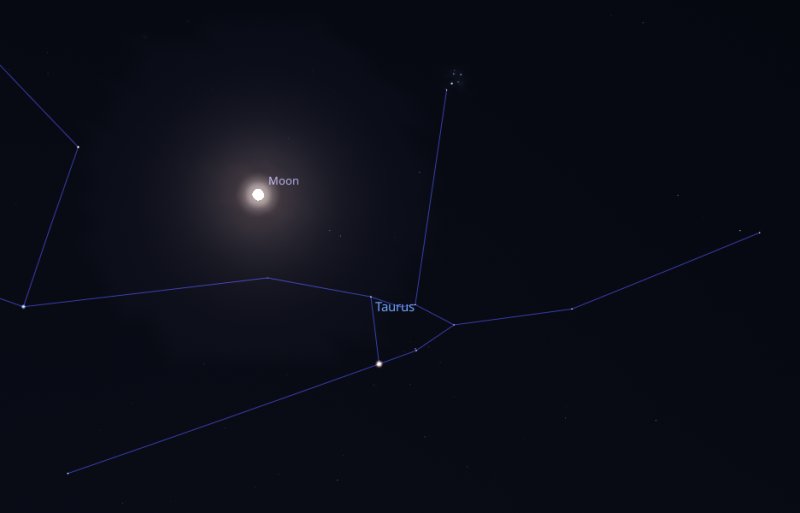
If that's a bit too much of an unsociable
hour for you, pop back outside around 7pm on the Thursday evening and look
towards the east, where you will find what has then become a Full Moon
rising above the horizon. It will be just above the constellation of Taurus
and heading towards the Pleiades again. This Full Moon occurs close to
perigee, when the Moon is closest to us in its orbit around the Earth, so it
will appear slightly larger than at other times, when it is at apogee and
furthest away from us. |
| |
 |
| |
|
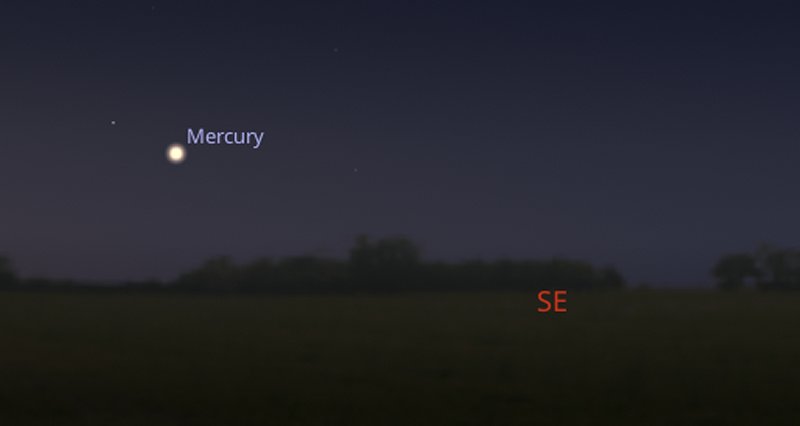
If you are up early on Sunday 7th, Mercury
reaches its greatest elongation and will be 20 degrees away from the rising
Sun, so this is an ideal opportunity to observe it. By 6.30am, the planet
will have risen above the horizon towards the south east. |
| |
 |
| |
|
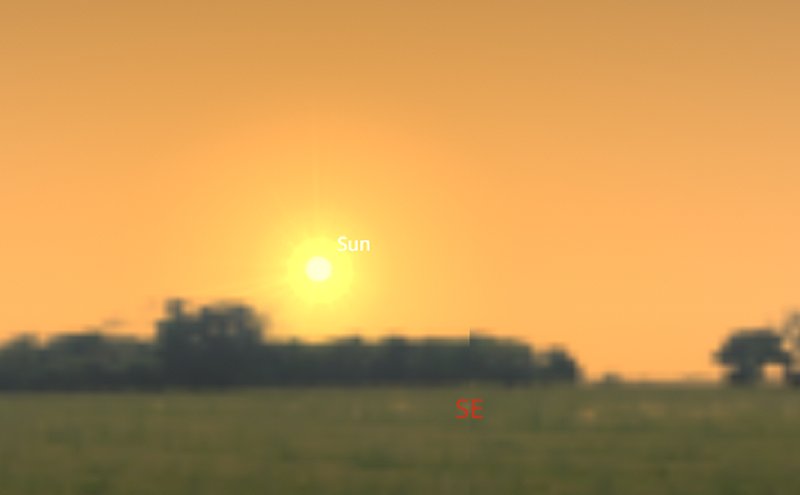
Please don't be tempted to use binoculars or
a telescope to obtain a better view though, because the Sun will be
appearing in the same place shortly afterwards and you mustn't risk catching
even the tiniest glimpse of it in your eyepiece! |
| |
 |
|
Monday 24th to
Sunday 30th November 2025 |
| |
|
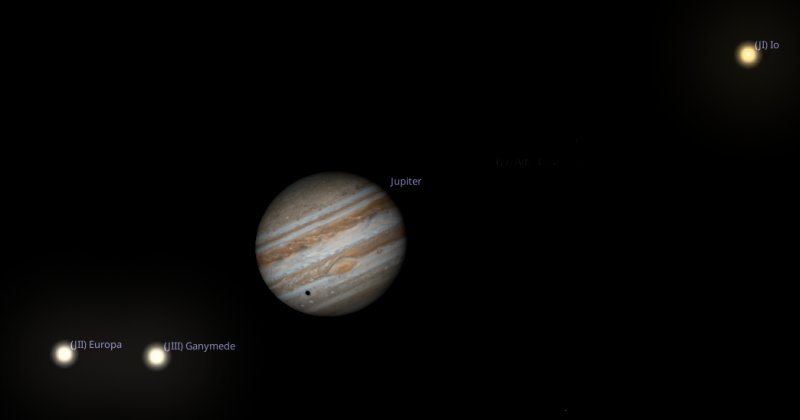
Last week I mentioned the shadows of two of
Jupiter's moons, Io and Callisto, being cast on to the planet's surface.
This coming week, it is the turn of another moon, Ganymede, to do the same.
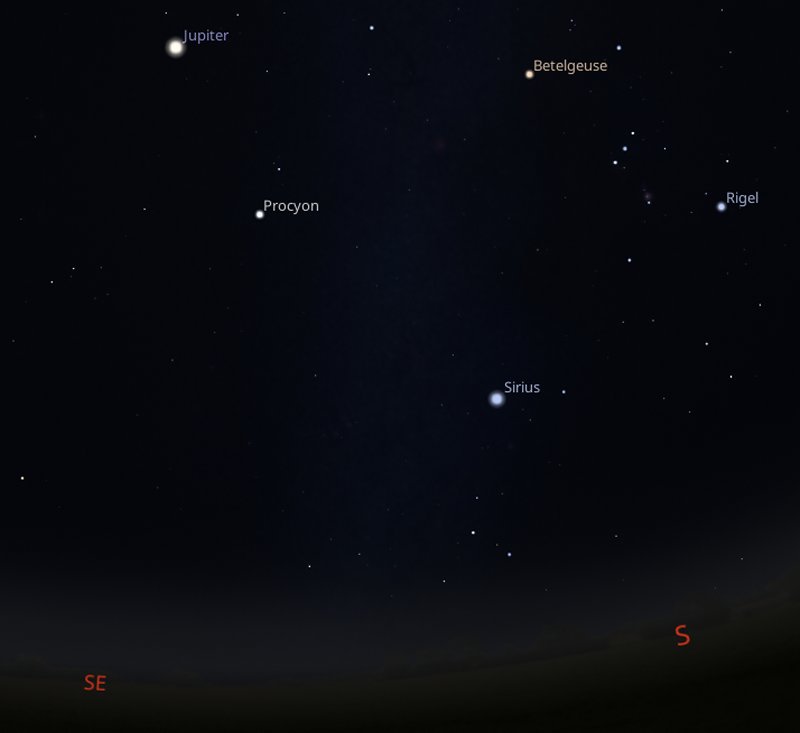
The Galilean moon's shadow can be observed between about 2am and 5am on
Tuesday 25th and at 2am, you would be needing to aim your telescope towards
the south east to catch it. |
| |
 |
| |
 |
| |
|
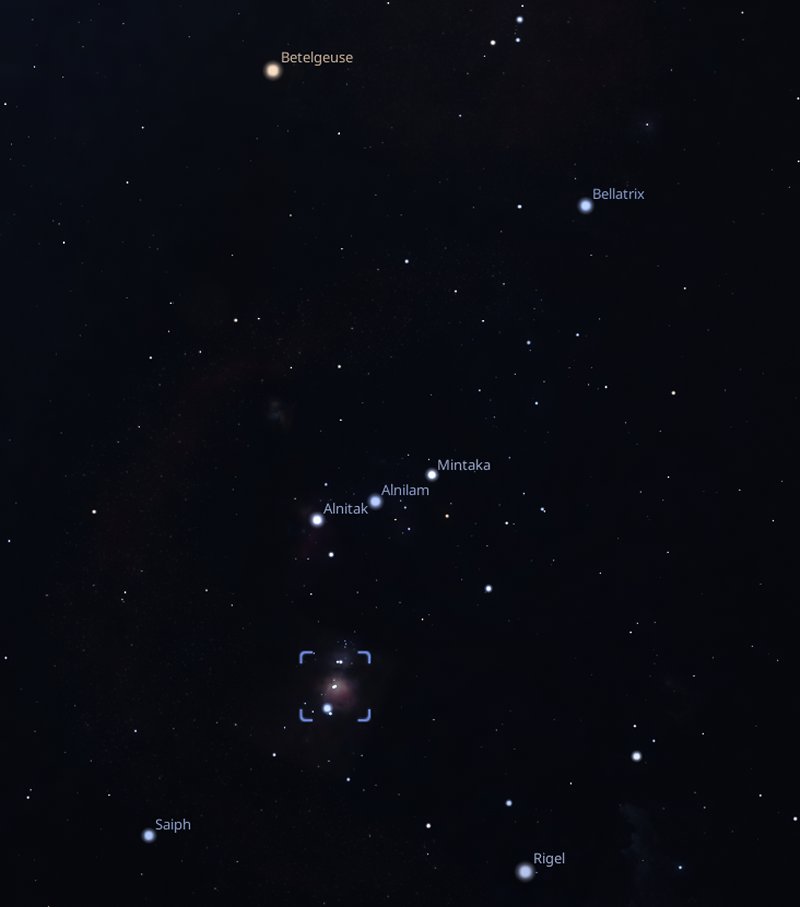
If at the same time, you look to the right of
Jupiter and a little below it, you will be able to see the bright star,
Procyon and the brightest star in the night sky, Sirius. To the right of
them, the constellation of Orion will be easy to find. |
| |
|
Why not have a go at spotting the Great Orion
Nebula M42, located in the "sword" of Orion while you are there. M42 is
classed as an "emission" nebula where light is radiated from its gasses and
it is where stars are born. The nebula is about 1600 light years away from
us, so if you observe it next week with your telescope, you will actually be
seeing the nebula how it looked 1600 years ago! |
| |
 |
| |
|
If that sounds amazing and you would like to
learn more, the first of my astronomy talks and star parties for this season
will be taking place at the Ham Hill Visitor Centre on the evening of Friday
28th November. There will be a one-hour talk about the night sky at 7pm and
then if it is clear, we venture outside. Places always fill quickly, so
booking is essential via the Ham Hill Rangers Office on 01935 823617. |
| |
|
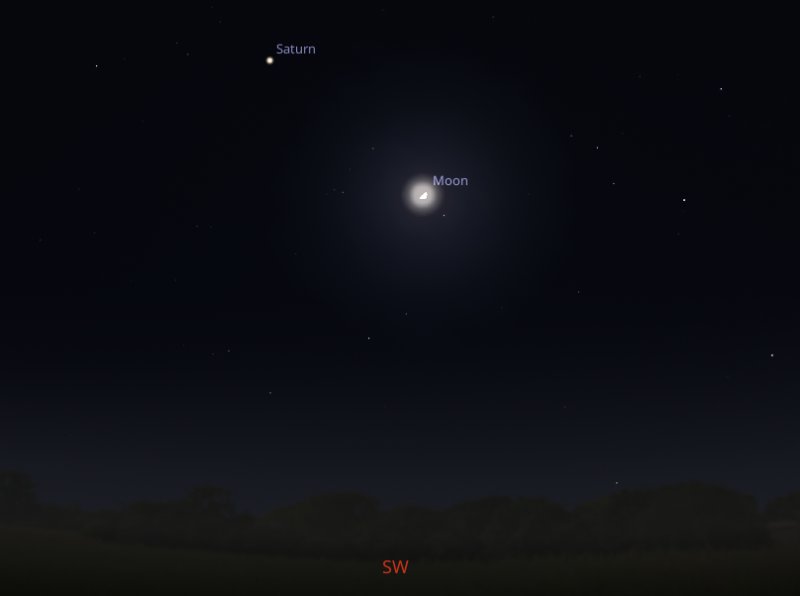
The following evening, Saturday 29th, it
should be possible to observe a 65%-lit waxing gibbous Moon close to Saturn
if you look towards the south west around 9pm as the pair set below the
horizon. |
| |
 |
|
Monday 17th to
Sunday 23rd November 2025 |
| |
|
The evening of Monday 17th sees the peak of
the annual Leonids meteor shower, with the actual peak occurring at 6pm.
Around the peak, the shower can produce up to 15 shooting stars per hour -
this is known as the Zenithal Hourly Rate. |
| |
|
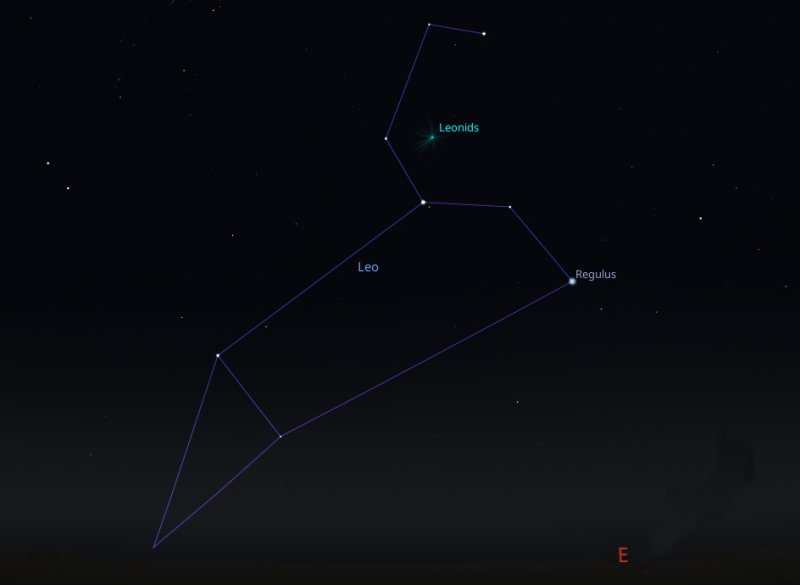
However if you go outside at that time, you
won't see a thing, as the constellation of Leo (where the radiant point of
the shower is located, near the lion's head) will still be below the
horizon. You will need to stay up late, when the constellation appears
above the eastern horizon from after midnight on the Tuesday morning. |
| |
 |
| |
|
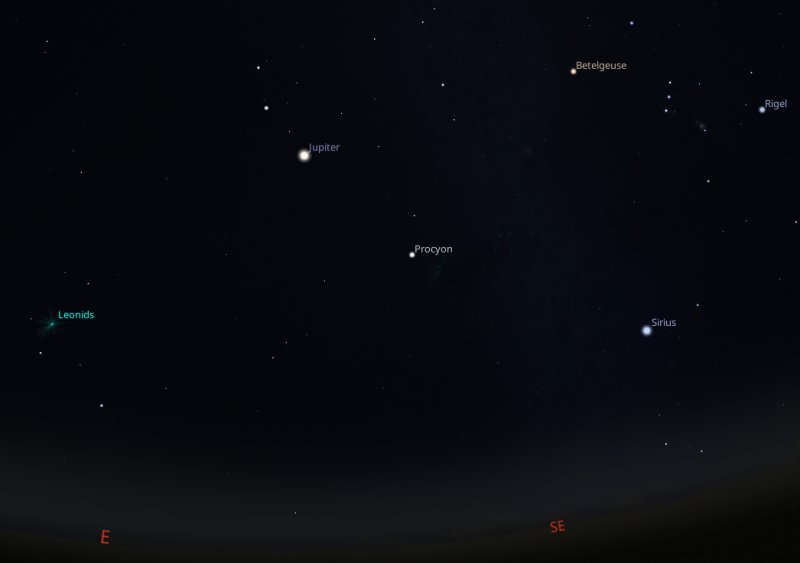
That's close enough to the peak and as a
bonus, there will be no light pollution from the Moon, which will still be
well-below the horizon. Of course you don't need a telescope to see the
spectacle, but if you want to do a bit more exploring, Jupiter will be
located a little above and to the right of Leo, with the constellation of
Orion further to the right. |
| |
 |
| |
|
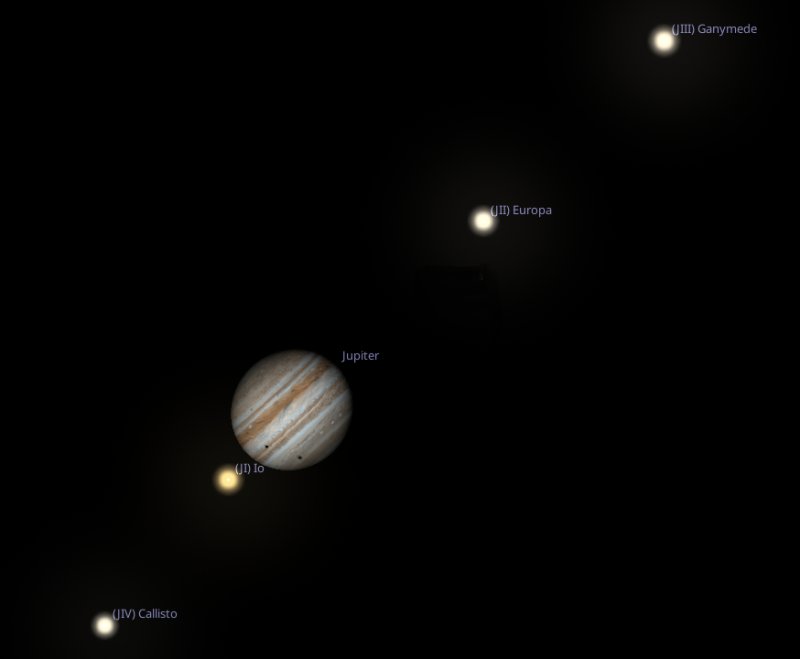
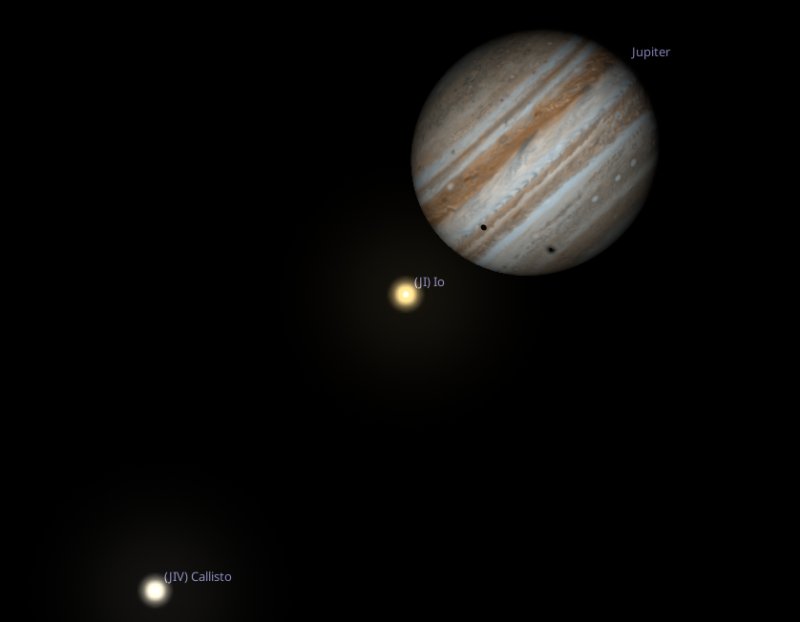
Aiming a telescope at Jupiter will often
reveal its four Galilean moons, unless one of them is hidden orbiting around
the other side of the planet at the time. Try looking at Jupiter around 2am
on Friday 21st to catch the shadow of two of its moons, Io and Callisto,
simultaneously being cast onto the planet's surface. At that time, Jupiter
will be found towards the east again, like on the Monday night and you
should be able to see all four moons - the exact same sight that Galileo
witnessed back in 1610 when he first-realised that the moons were orbiting
around the planet - back then, everyone thought that all heavenly bodies
circled the Earth! |
| |
 |
| |
 |
|
Monday 10th to
Sunday 16th November 2025 |
| |
|
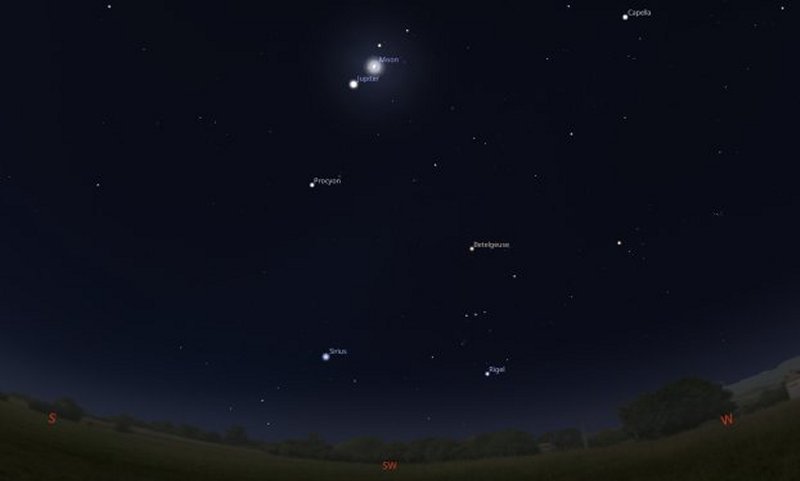
If you look towards the south west at 6am on
Monday 10th, the constellation of Orion with its bright stars Betelgeuse and
Rigel will be easy to spot. To the left of Orion will be the brightest star
in the night sky, Sirius, that has a magnitude of -1.44 while a little above
Sirius, you will find another bright star called Procyon. Procyon is
actually a double star with a magnitude of +0.4 |
| |
 |
| |
|
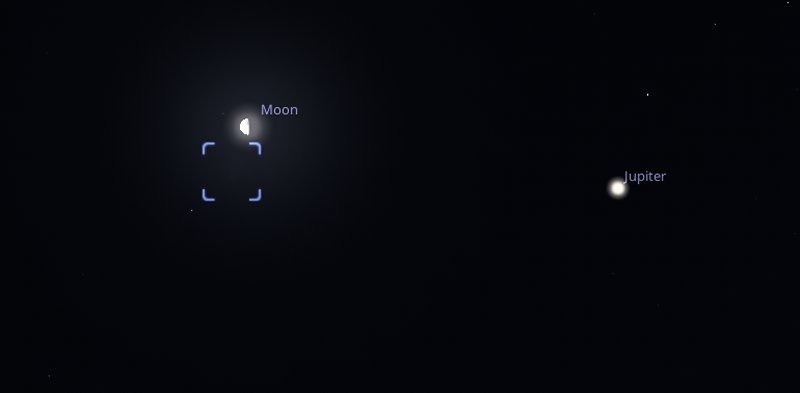
Look above Orion to see something even more
obvious.....a 71%-lit waning gibbous Moon extremely close to Jupiter. Note
that the Moon is a little to the right of Jupiter. |
| |
|
All of these targets will be easy to spot
with the naked eye, so no telescope necessary! |
| |
|
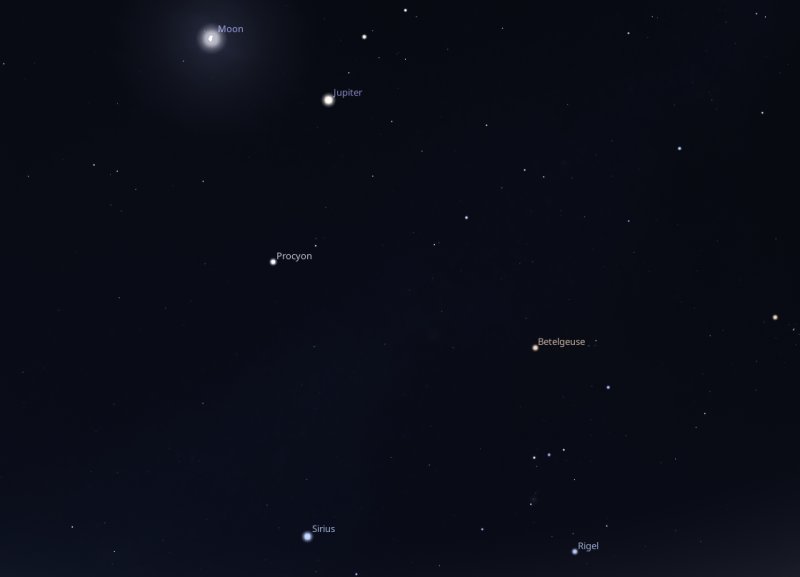
Look again at the same time and in the same
direction the following morning, Tuesday11th and everything will appear to
be in near-enough the same place, except that the Moon will now be a 60%-lit
gibbous shape and it will be located to the left of Jupiter. This is
because the Moon is orbiting around us, so it appears to move completely
differently to everything else in the night sky. |
| |
 |
| |
|
If you're really feeling the urge to dig out
that telescope, just below the Moon, you could try to spot the Beehive open
cluster of stars which is M44 in the Charles Messier catalogue, but the view
is likely to be disappointing because of the light pollution created by the
Moon. |
| |
 |
|
Monday 3rd to
Sunday 9th November 2025 |
| |
|
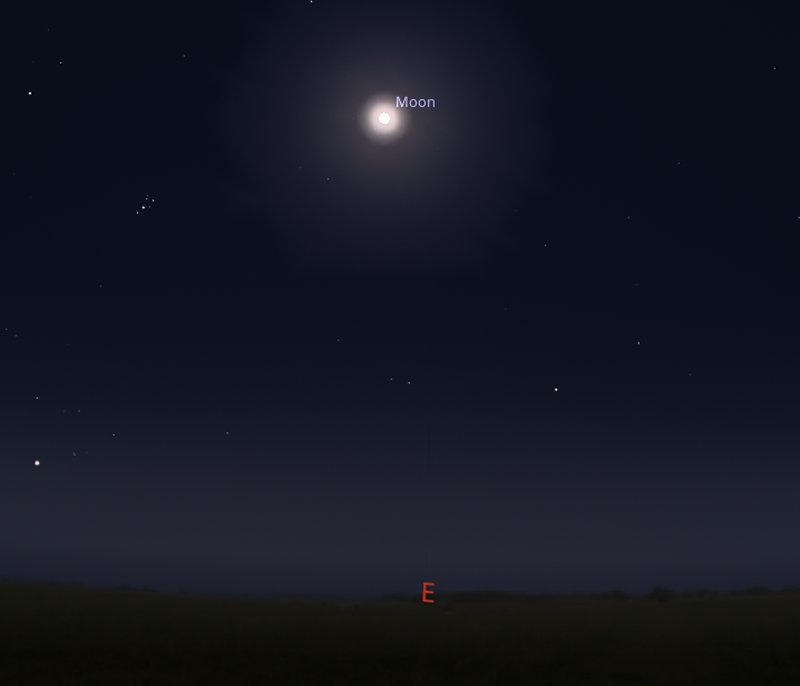
Back on 7th October we had a Supermoon, so
named because the Full Moon occurred close to perigee, when our natural
satellite was closest to us in its orbit around the Earth. At that point,
it appeared 14% larger than when it's furthest from us, at apogee. On
Wednesday 5th November, we have the next Full Moon and once again, it will
be very close to perigee. At 7pm, the Moon will be located towards the
east. |
| |
 |
| |
|
To use the correct astronomical terms, rather
than saying "14% larger", the Moon will appear to have an apparent diameter
of 33.3 arcminutes as opposed to 31.0 arcminutes. What on Earth does that
mean? An arcminute is one sixtieth of a degree. An arcsecond is one
sixtieth of an arcminute. These units are used to measure very small angles
in science fields. Quite logical, but personally, I think "14% larger" is a
lot easier to understand! |
| |
|
I didn't mention comet C/2025 A6 Lemmon last
week because you probably wouldn't have been able to see it! Remember that
from a very dark location, you can resolve objects down to a magnitude of
around +6.0 with the naked eye. Binoculars or a very small telescope will
enable you to spot things down to a magnitude of +8.0 and for anything
fainter than that, it is serious telescope time. The comet was predicted to
have a magnitude of only around +10, but comet brightness is notoriously
hard to predict and in the end, some people observed it around +4.0 |
| |
|
The press is reporting comet 24P/Schaumasse
passing through the Beehive Cluster M44 next week, but don't get too
excited, because this comet will have an estimated magnitude of +14.3 so
will be even dimmer! |